The 24 Dec 1964 edition of The Matawan Journal (pg 11 col 4) announced that the Strathmore-at-Matawan Jewish Center* had just changed its name to Temple Beth Ahm, House of the People. The temple, the only conservative congregation between Red Bank and South Amboy, hoped the less geographically specific name would draw members from a broader region.
The temple had 183 members and its school 125 students at the time of this article's publication. The congregation had purchased a home for its spiritual leader, Rabbi Morris L Rubenstein, at 73 Idlewild Lane in Strathmore.
* Strathmore-at-Matawan was an early name for the Strathmore section of what is now Aberdeen Township, so the center was alternately referred to as the Strathmore, Matawan, and the Strathmore-at-Matawan Jewish Center.
A few earlier mentions of this and other Hebrew congregations in the Journal:
The 10 Dec 1964 edition of The Matawan Journal announced that the Strathmore-at-Matawan Jewish Center would be holding worship services on 18 December at Matawan Regional High School.
The 24 Oct 1963 edition of The Matawan Journal (pg 5 col 7) said a meeting of the Strathmore Jewish Center would be held that evening at the Matawan Township First Aid Squad building at Prospect Avenue and Amboy Road in Cliffwood. Martin Cooper, president of the congregation, urged all members to attend to discuss the Temple's future plans.
The 14 Sep 1950 edition of The Matawan Journal (pg 10 cols 2-3) included a photograph of the synagogue of the United Hebrew Congregation of Keyport.
The 11 May 1889 edition of The Matawan Journal said the First Baptist Church of Newark was meeting in the local Jewish synagogue while the Baptist's edifice was being completed.
The 28 Jul 1888 edition of The Matawan Journal announced the dedication of the House of Miriam Jewish synagogue in Long Branch.
Showing posts with label baptists. Show all posts
Showing posts with label baptists. Show all posts
Friday, July 26, 2013


Tuesday, July 23, 2013
History: Matawan Churches Form Temperance Union (1884)
The 26 Jul 1884 edition of The Matawan Journal (pg 4 col 3) announced the formation of a joint temperance committee uniting the local Methodists, Presbyterians and Baptists in Matawan.
Matawan Temperance Alliance
A joint meeting was held on Monday evening at the residence of Rev F A Slater, of the Temperance Committees of the Methodist, Presbyterian and Baptist Churches of Matawan. The object of the meeting was to arrange for joint work in furthering the neglected cause of temperance in our midst.
The meeting was organized by electing Rev H G Williams as President of the Joint Committee; Rev F. A, Slater, Vice President; W V Simpson, Esq, Secretary; and David A Bell, Treasurer.
An Executive Committee was chosen, consisting of the pastor and one layman from each church, whose duty it is to arrange for public meetings. The general necessity for more active temperance work was spoken of by all present.
The Executive Committee met and organized after the adjournment of the Joint Committee, by electing Rev R J Kent chairman and Prof Jacobus secretary; Mr A H Harris, acting as secretary pro tem. It was agreed to hold a Union Temperance meeting in the Presbyterian Church on the second or third Sunday evening in September, and Rev R J Kent and Rev F A Slater were appointed to secure a speaker.
--------------------------------------
Rev Henry G Williams, born about 1837 in Pennsylvania, was a Methodist Episcopal preacher who was associated with churches in Lambertville, Long Branch, Toms River, Angelton and Matawan, among others. He preached at Centenary Methodist in Lambertville beginning in 1879 and was there for the 1880 Federal Census, along with wife Susannah, daughter, and a servant. He gets a brief mention in a number of church histories online.
Reverend Franklin A Slater was born about 1823 in New York and served as the pastor of the Matawan Baptist Church from 1856 to 1862. He was widowed and living in Matawan in 1880. His son Frank was operating the Washington Hall Pharmacy in Matawan in 1880. (See A 1904 History of Baptists in Keyport and Matawan and Professionals and Businessmen of Matawan, 1880)
William V Simpson, born 1846 in New York, was on the Board of Trustees of the Presbyterian Church in Matawan in September 1908. (See Dr Alexander Young, Pastor, First Presbyterian Church (1894-1907)) The 1900 Federal Census enumerated him as a lawyer living in Matawan along with wife Emma and two children.
David A Bell was the owner of The Matawan Journal.
Charles Jacobus was principal at the Glenwood Institute.
Alex H Harris, 62 year old, was operating a hardware store in Matawan with his son W Kramer Harris in 1880. Presumably an early iteration of Harris Hardware.
Rev Robert James Kent was pastor of the First Presbyterian Church of Matawan from 1883 to 1888. He was born 28 Dec 1855 in New York City. He graduated from Union Theological Seminary in 1880 and was ordained by the Presbytery of New Brunswick. He served the Kirkpatrick Memorial Church in Ringoes, NJ from 1880 to 1883, then moved to Matawan. He left the Presbyterian denomination in 1888 and became pastor of a Congregational church in Brooklyn. (See his obituary in an August 1941 edition of The Brooklyn Daily Eagle at Fulton History)
Matawan Temperance Alliance
A joint meeting was held on Monday evening at the residence of Rev F A Slater, of the Temperance Committees of the Methodist, Presbyterian and Baptist Churches of Matawan. The object of the meeting was to arrange for joint work in furthering the neglected cause of temperance in our midst.
The meeting was organized by electing Rev H G Williams as President of the Joint Committee; Rev F. A, Slater, Vice President; W V Simpson, Esq, Secretary; and David A Bell, Treasurer.
An Executive Committee was chosen, consisting of the pastor and one layman from each church, whose duty it is to arrange for public meetings. The general necessity for more active temperance work was spoken of by all present.
The Executive Committee met and organized after the adjournment of the Joint Committee, by electing Rev R J Kent chairman and Prof Jacobus secretary; Mr A H Harris, acting as secretary pro tem. It was agreed to hold a Union Temperance meeting in the Presbyterian Church on the second or third Sunday evening in September, and Rev R J Kent and Rev F A Slater were appointed to secure a speaker.
--------------------------------------
Rev Henry G Williams, born about 1837 in Pennsylvania, was a Methodist Episcopal preacher who was associated with churches in Lambertville, Long Branch, Toms River, Angelton and Matawan, among others. He preached at Centenary Methodist in Lambertville beginning in 1879 and was there for the 1880 Federal Census, along with wife Susannah, daughter, and a servant. He gets a brief mention in a number of church histories online.
Reverend Franklin A Slater was born about 1823 in New York and served as the pastor of the Matawan Baptist Church from 1856 to 1862. He was widowed and living in Matawan in 1880. His son Frank was operating the Washington Hall Pharmacy in Matawan in 1880. (See A 1904 History of Baptists in Keyport and Matawan and Professionals and Businessmen of Matawan, 1880)
William V Simpson, born 1846 in New York, was on the Board of Trustees of the Presbyterian Church in Matawan in September 1908. (See Dr Alexander Young, Pastor, First Presbyterian Church (1894-1907)) The 1900 Federal Census enumerated him as a lawyer living in Matawan along with wife Emma and two children.
David A Bell was the owner of The Matawan Journal.
Charles Jacobus was principal at the Glenwood Institute.
Alex H Harris, 62 year old, was operating a hardware store in Matawan with his son W Kramer Harris in 1880. Presumably an early iteration of Harris Hardware.
Rev Robert James Kent was pastor of the First Presbyterian Church of Matawan from 1883 to 1888. He was born 28 Dec 1855 in New York City. He graduated from Union Theological Seminary in 1880 and was ordained by the Presbytery of New Brunswick. He served the Kirkpatrick Memorial Church in Ringoes, NJ from 1880 to 1883, then moved to Matawan. He left the Presbyterian denomination in 1888 and became pastor of a Congregational church in Brooklyn. (See his obituary in an August 1941 edition of The Brooklyn Daily Eagle at Fulton History)
Monday, December 31, 2012
Eleanor Van Brakle, Teacher (1869 - 1956)
 |
| Public School, Matawan, NJ |
The post card was addressed to an Eleanor Van Brackle of Keyport. Someone named Mary, perhaps her student or a fellow teacher, thanked Ms Van Brackle for the "postal" (post card or letter) and "the lessons you sent". The card is postmarked October at Keyport, but the precise date and year are illegible.
I found the following about Eleanor in the census and local newspapers:
The 1870 Federal Census showed Ella Van Brackle (2) in the Matawan household of her parents, Thos E (34) and Elizabeth (30) Van Brackle. Thomas was a farmer. Also in the household were Ella's elder brother Frank Van Brackle (4), (her uncle?) George Van Brackle (28), and (her grandmother?) Ann Van Brackle (60). Note: Thomas and Elizabeth had another son named Frank born about 1863 who died 18 Dec 1864 in Matawan.
The 1880 Federal Census showed Eleanor Van Brackel, age 11, daughter of Thomas (44) and Elizabeth (39) Van Brackel. Thomas listed no occupation. The family was living on Broadway in Raritan. Eleanor's siblings were Franck (14), Mary (8), Fred (7), and Thomas (2). Note: Son Fred was born 22 Sep 1872 in Matawan.
The 1900 Federal Census showed Eleanor Van Brakle born Aug 1869 in New Jersey. She was living with her parents, Thomas (Dec 1835 NJ) and Elizabeth (Nov 1840 NJ) Van Brakle, and sibling Frank Van Brakle (Feb 1868 NJ), in Raritan. Her parents had been married 39 years and her mother had four surviving children from among the six she'd borne.
The 1910 Federal Census showed Eleanor Van Brakle, age 40, born in New Jersey to NJ parents, single, living on Warren Street in Keyport. Her occupation was listed as teacher, high school.
The 1920 Federal Census showed Eleanor Van Brakle, age 51 NJ, as vice principal in a high school. She was living on Holmdel Turnpike in Holmdel and was listed as the sister-in-law of the head of household Charles I Young (50 NJ) and his wife, Mary (48 NJ). Charles owned a farm.
The 1930 Federal Census showed Eleanor Van Brakle, age 61 NJ, as a teacher at a school. She was born in Matawan to parents born in Holmdel. She was still living with Charles and Mary. Note that Mary was also born in Matawan to Holmdel parents and is very likely Eleanor's sister.
The 19 Jun 1936 edition of The Matawan Journal (pg 3 col 3) contained a society piece saying that Donald Van Brackle, of Crown Point, NY, was visiting his aunt Eleanor Van Brackle to attend a class reunion at Rutgers University.
The 1940 Federal Census showed Eleanor Van Brakle, age 71 NJ, living at 138 Main Street in Keyport. She was not employed and was not seeking employment.
The 27 Feb 1941 edition of The Red Bank Register (pg 23 col 4) said that Eleanor Van Brakle was elected to the board of trustees of the Keyport Free Library in the position of treasurer.
The 3 May 1945 edition of The Red Bank Register (pg 20 col 3) said that Eleanor Van Brakle was re-elected secretary of the missionary society at the First Baptist Church in Keyport.
The 18 Sep 1947 edition of The Red Bank Register (pg 17 col 4) said Eleanor Van Brakle attended a meeting of the Women's League of the First Baptist Church of Keyport.
Eleanor Van Brakle (2 Aug 1869 - 2 Oct 1956) is buried at Green Grove Cemetery in Keyport, according to Distant Cousin. (Image of her gravestone)
The First Baptist Church of Keyport had an Eleanor Van Brakle Girls' Guild, according to the 19 May 1960 edition of The Matawan Journal.
Saturday, December 1, 2012
History: Renovation of Second Baptist Church, Matawan (1972)
The 22 Jun 1972 edition of The Matawan Journal included the article below about a planned renovation of the Second Baptist Church of Matawan.
MATAWAN — Plans are underway to modernize the facilities of the Second Baptist Church, 45 Orchard St.
Mrs. Luvenia (Wicker) Wall, 83 years old, a member of the church, though inactive, remembers attending Sunday School in Bissel Hall, the Reform club rooms, and at one time services were held in a schoolhouse on Rabbit Lane. From this congregation began the Berean Baptist Church, located on Jackson St., which was incorporated Apr. 8, 1890. The Seacost Baptist Association of New Jersey was organized in this church.
The congregation needed larger quarters and a church was erected on Orchard St. In April 1894, the name was changed from the Berean to the Second Baptist Church of Matawan. The current pastor is the Rev. Joseph K. Butts, who has been a member of the church since early childhood. William Rice, chairman of the building committee, and Roy Mancel, chairman of the trustees, concluded that in order to meet the needs of the membership and the community it was necessary for the church to be completely modernized.
The modernization will take place in three phases, the first renovating of the exterior of the parsonage and paneling of walls in two rooms. The work on the church will consist of installing brick veneer to the exterior walls and new stained glass windows. The third and final phase will be the landscaping of the church grounds.
Total cost of the project is estimated, at $50,000. The work will be completed at funds become available, but it is hoped that most of the work will be completed prior to Christmas of this year. The architect is Preston C. Moore, Matawan, and contractor, Robert Vargo, Old Bridge.
---------------------------------------------------
Given that the Reverend Butts retired in 2000 after serving the church for over 27 years, the above article would have marked the beginning of his ministry. Since he planned major renovations to the building, he obviously started his ministry with a bang.
Reverend Anthony L Hodges filled the vacant pulpit at Second Baptist in 2003, according to the 19 Mar 2003 edition of The Independent.
MATAWAN — Plans are underway to modernize the facilities of the Second Baptist Church, 45 Orchard St.
Mrs. Luvenia (Wicker) Wall, 83 years old, a member of the church, though inactive, remembers attending Sunday School in Bissel Hall, the Reform club rooms, and at one time services were held in a schoolhouse on Rabbit Lane. From this congregation began the Berean Baptist Church, located on Jackson St., which was incorporated Apr. 8, 1890. The Seacost Baptist Association of New Jersey was organized in this church.
The congregation needed larger quarters and a church was erected on Orchard St. In April 1894, the name was changed from the Berean to the Second Baptist Church of Matawan. The current pastor is the Rev. Joseph K. Butts, who has been a member of the church since early childhood. William Rice, chairman of the building committee, and Roy Mancel, chairman of the trustees, concluded that in order to meet the needs of the membership and the community it was necessary for the church to be completely modernized.
The modernization will take place in three phases, the first renovating of the exterior of the parsonage and paneling of walls in two rooms. The work on the church will consist of installing brick veneer to the exterior walls and new stained glass windows. The third and final phase will be the landscaping of the church grounds.
Total cost of the project is estimated, at $50,000. The work will be completed at funds become available, but it is hoped that most of the work will be completed prior to Christmas of this year. The architect is Preston C. Moore, Matawan, and contractor, Robert Vargo, Old Bridge.
---------------------------------------------------
Given that the Reverend Butts retired in 2000 after serving the church for over 27 years, the above article would have marked the beginning of his ministry. Since he planned major renovations to the building, he obviously started his ministry with a bang.
Reverend Anthony L Hodges filled the vacant pulpit at Second Baptist in 2003, according to the 19 Mar 2003 edition of The Independent.
Sunday, June 24, 2012
History: Mayor Robert G Thixton, Matawan (1895-1964)
 |
| The 24 Jun 1948 edition of The Matawan Journal contained this Oldsmobile advertisement sponsored by the Robert G Thixton dealership on Main Street in Matawan. The ad was promoting tune ups: Keep Your "Merry Oldsmobile" In Tune. |
Below is a timeline of information available about Robert G Thixton, born Robert Gerard Thickstun, who served Matawan Borough as Mayor for one term (1945-1947) and Councilman for two consecutive terms (1936-1942). He was born in Plainfield, NJ on 5 Jan 1895 and died at Monmouth Medical Center in Long Branch on 11 Oct 1964.
As you can see above, he sold automobiles from a dealership on Main Street in Matawan for many years. He served in the military in World War I and worked for the War Department at Camp Kilmer early in World War II. He also clerked at a New York City brokerage.
His future wife, Theresa, was born 21 May 1898.
The 1900 Federal Census for New Jersey showed Robert G Thickstun living with his parents and siblings in the household of his great aunt Mary J Thickstun. The address was 407 Central Avenue, Plainfield, NJ. His father, William D Thickstun was a real estate agent. (The record has a number of errors. Perhaps the enumerator interviewed the aunt?)
The 1910 Federal Census for New Jersey showed Robert G Thickstun, 15 years old, living at 403 Central Avenue in the Plainfield household of William (43) and Elizabeth V Thickstun (38). William worked in real estate. His siblings were David B (20), William D (17), and Gerald Thickstun (13).
Robert Gerard Thickstun registered for the WWI draft on 5 Jun 1917. The form said he was born 5 Jan 1895 in Plainfield, NJ. He was living at 403 Central Avenue in Plainfield. He was working as a clerk at F S Moseley & Co, 26 Exchange Place, New York, NY. He had blue eyes and brown hair.
The 1920 Federal Census for New Jersey showed Robert G Thickstun, 24 years old, living at 403 Central Avenue in the Plainfield household of William D (53 yrs old) and Elizabeth V Thickstun (48). Robert's brother Gerald (23) and their grandmother Elizabeth Thickstun (84) lived in the household.
He lived at 403 Central Avenue in Plainfield, NJ in 1922, according to a local city directory. He was in the household of Elizabeth Thixton, widow of Daniel H Thixton. Others in the household were Gerald Thixton and William D Thixton, the latter in real estate.
He bought the Main Street property of J August Sochl to be used for a "Chevrolet sales room," according to the 17 Feb 1928 edition of The Matawan Journal. He was due to take possession of the property on 1 Apr 1928.
He bagged a pheasant in Matawan, according to the 16 Nov 1928 edition of The Matawan Journal. The game warden had released 100 rabbits and a couple dozen pheasants in the Matawan area the previous summer. The hunting exploits of numerous members of the community are mentioned.
The 1930 Federal Census for New Jersey showed Robert Thixton, age 35, auto dealer, as head of household at 108 Main Street in downtown Matawan. His wife, Theresa, was 32 years old. They had $25,000 in property.
He and Samuel Bell, of Bell Beef Company, were involved in organizing two of Matawan's twilight league baseball teams, according to a rather amusing investigative article in the 23 Feb 1934 edition of The Matawan Journal.
At the same time Mayor Edward W Currie won his third term in Matawan Borough, Thixton won as Democratic councilman, according to the 8 Nov 1935 edition of The Matawan Journal. In a separate article, Thixton reported weekly sales at Thixton Chevrolet-Oldsmobile Sales and Service in Matawan reached the impressive level of 7 new automobiles. The front page article actually listed the names of those who purchased the cars. See also the 18 Nov 1935 edition of The Matawan Journal.
The Mayor named him to the Finances Committee for Matawan's 250th anniversary celebration, according to the 15 May 1936 edition of The Matawan Journal.
The 12 Jun 1936 edition of The Matawan Journal contained several Thixton ads, including one for used cars and another for Chevrolet trucks. An article towards the back of the paper said Thixton had sold 24 new cars in May 1936, listing a number of the customers and the cars they bought.
The 16 Jul 1936 edition of The Matawan Journal announced his sale of 110 Main Street for $30,000. The property included a dwelling, store, repair shop, and bungalow. Frontage on Main Street was 122.5 feet. The property was 316 feet deep and 63.5 feet across at the back of the lot. The same paper announced that the annual picnic of the Ladies Auxiliary of Matawan's American Legion post would be held at Mrs Thixton's summer home at Metedeconk, described by New Jersey History's Mysteries as "a fishing and shipping village located at the mouth of the Metedeconk River" in present day Brick Township.
He threw a 50th anniversary party for his parents at his home in Matawan, according to the 11 May 1939 edition of The Red Bank Register. His parents lived in Matawan. He was a councilman at the time.
Robert Girard Thixton registered for the World War II draft in 1942. The draft form said he was born 5 Jan 1895 in Plainfield, NJ. He lived on Edgemere Drive in Matawan. He listed two phone numbers: Matawan 1970 and Matawan 2049. He worked for the War Department, US Engineers, NYDE, at Camp Joyce Kilmer, Stelton, NJ. (I had no luck with the NYDE acronym.)
He was to serve as a delegate to the state convention of the American Legion, representing the Matawan Post, according to the 30 Aug 1945 edition of The Matawan Journal.
As a local businessman and member of American Legion Post 176, he worked on Legionnaires Week, which included a fair at the high school on 30 Jun 1947 and 4th of July festivities, according to the 26 Jun 1947 edition of The Matawan Journal.
The 30 Oct 1947 edition of The Matawan Journal covered Mayor Thixton's third campaign appearance, the last one before the upcoming election. He was a Republican and was running against Democratic candidate John W Applegate.
The Thixton's daughter Jean Thixton attended Centenary Junior College, according to the 17 Mar 1949 edition and several other issues of The Matawan Journal. Centenary, located in Hackettstown, NJ, was founded by the Methodist church in 1867 as a co-educational preparatory school. It became a girls preparatory school in 1910 and then a women's junior college in 1940. Currently co-educational again, the school is now called Centenary College of New Jersey.
 |
| Robert G Thixton Olds ad appeared in the 5 Jan 1950 edition of The Matawan Journal. |
The 24 Sep 1953 edition of The Matawan Journal featured the dedication of the First Baptist Church of Matawan's new Sunday School building earlier that week. Mr. Thixton worked on the building committee, as reported on pg 4.
He served on the Board of Trustees of the Matawan Business Association, according to the 26 Jun 1952 edition of The Matawan Journal. His term was set to expire in 1955.
 |
| This Thixton Chevrolet ad appeared in the 3 Nov 1955 edition of The Matawan Journal. |
He and Theresa maintained a second residence at 231 NE 8th Boulevard in Boca Raton, Florida in the late 1950s and early 1960s.
He died 11 Oct 1964 and is buried in the Oak Hill section of Old Tennent Cemetery, Tennent, NJ.
The 12 Oct 1964 edition of The Red Bank Register included this obituary for R G Thixton:
R. C. Thixton, Matawan, Dies
MATAWAN — Robert G. Thixton, 69, of 5 Edgemere Dr., died yesterday in Monmouth Medical Center, Long Branch.
Mr. Thixton was a former mayor and a councilman here.
He was born in Plainfield, son of the late William D. and Elizabeth Taylor Thixton. He had lived here for 40 years.
Mr. Thixton was a retired automobile dealer. He was a member of the First Baptist Church, Masons and American Legion of this place, Crescent Temple, Trenton, and was a past commander of the Monmouth County American Legion. He also was a veteran of World War I.
Surviving are his wife, Mrs Theresa Jocham; a daughter, Mrs. Jean May of this place; three brothers, Dr. David Thickstun of Plainfield, and William D. and Gerald Thixton, both of Fort Lauderdale, Fla.; and three grandchildren.
The funeral will be Wednesday at 1 p.m. in the Bedle Funeral Home, here, with Rev. Robert Addie, pastor of the First Baptist Church, officiating. Burial will be in Old Tennent, Cemetery, Tennent.
The 15 Oct 1964 edition of The Matawan Journal contained the following obituary:
Robert G. Thixton
Robert G. Thixton, 69, of 5 Edgemere Dr., Matawan, who formerly served as mayor of Matawan for two years and who was a member of the Borough Council for six years, died Sunday, Oct. 11, 1964, at Monmouth Medical Center.
Mr. Thixton was elected mayor of Matawan in 1945 and served from January 1945, for a two-year term. He served on the borough council for two three-year terms from 1936 through 1942.
Mr. Thixton was retired. He had been an automobile dealer of Chevrolet and Oldsmobile cars in Matawan for many years. He was a member of Matawan Masonic Lodge 192 of which he was a past worshipful master, and was affiliated with Crescent Temple, Trenton, Ancient Arabic Order, Nobles of the Mystic Shrine. He was a member of the First Baptist Church of Matawan.
A veteran of World War I, Mr. Thixton was a past commander of Monmouth County Post American Legion and of Matawan Post 176 American Legion.
Son of the late William D. Thixton and Mrs. Elizabeth (Taylor) Thixton, he had resided in Matawan 40 years. He was born in Plainfield.
Surviving are his wife, Mrs. Theresa (Jocham) Thixton, Matawan; a daughter, Mrs Jean May, Matawan; three grandchildren; three brothers, Dr. David Thickstun, Plainfield; William Thixton and Gerald Thixton, Fort Lauderdale, Fla.
Funeral services were held at 1 p.m. Wednesday in the Bedle Funeral Home, Matawan, with the Rev. Robert Addiss, pastor of the Baptist Church, officiating. Burial was in Old Tennent Cemetery.
Masonic funeral services were conducted by Matawan Lodge at 8 p.m. Tuesday at the funeral home. The 26 Nov 1964 edition of The Matawan Journal listed those who received lowered property tax assessments from the Monmouth County Board of Taxation. Robert received adjustments on the following properties:
- 110 Main Street (building), Matawan - reduced from $29,200 to $28,000
- Rear of 5 Edgemere Drive (land), Matawan - reduced from $2,200 to $1,700
- 5 Edgemere Drive (building), Matawan - reduced from $31,900 to $30,200.
Theresa died 27 Aug 1985 in Tobyhanna, Monroe County, Pennsylvania and is buried in the Oak Hill section of Old Tennent Cemetery, Tennent, NJ.
Thursday, November 24, 2011
History: Thanksgiving Celebrated in Matawan, 1871

This was followed on Thursday by an ecumenical service run by the ministers from the Baptist, Presbyterian, and Methodist churches. The service was held at the Methodist Church, which was located on Main Street about where the Dollar Store sits today.
The Presbyterian minister, J Henry Kaufman, delivered a sermon on the need for the churched to check corrupt political power. "If the men who hold political power are impure, the streams of influence will become corrupt. So it has been in profane and sacred history, and with such examples before us, let us take warning. The great preservative is the intelligence and purity of the people, and the duty of moral and religious men is to see that the ignorant are educated. And our magistrates should be wise, God-fearing, and eschewing covetousness."
Friday, April 1, 2011
History: AME Zion in Keyport, Henry Terhune in Jamaica

Sunday, March 20, 2011
History: Racial Conflict at Matawan Regional HS - Late Sept 1970
The front page of The Matawan Journal's 1 October 1970 edition contains reporting of racial tensions at the high school that eventually flared into riots and marauding youths. Some interesting materials for the African-Americans in The Matawan Journal series.
The reporting suggests at one point that the violence could have been caused by outsiders, possibly students or adults from rival schools stirring the pot before some important football games. At other times there are mentions that the violence was actually planned ahead of time or an unfortunate result of overcrowding at the high school. However it started, once there was violence, fear took over and rumors started to fly, turning things in the community even uglier. The Journal reported many of the rumors without comment, which might not have been the best approach. Police and school officials seemed to take a reasonable approach once they caught up with events, but the news coverage suggests that neither had their ears to the ground on this.
There is a stark difference between that school district and its current iteration. We should be thankful that our kids get along and strive to do so ourselves.
On a technical note, the online scanned images for this paper are abysmal, so I retrieved the original newspaper from the library archives, photocopied the articles, and transcribed them below for the record.
Five Days Student Turmoil
Racial conflicts flared anew at Matawan Regional High School during the past week following an outbreak at a dance on Friday night. Monday and Tuesday were tense days and nights for police, school, municipal authorities and parents, but rain last night cooled things somewhat and all are hopeful that tensions will ease when school resumes Monday after being closed today and tomorrow for the Jewish holiday.
Non-students as well as students suffered in the resulting violence. Harold F Dolan, a former president of the Matawan Regional Board of Education, who sought to disperse a group of youths who entered his property on Atlantic Avenue at the height of the disturbances Friday night received a cut on the arm before he drove the youths off.
This same group of 30 young Negroes were reported by another Atlantic Avenue householder to have smashed a $350 picture window of his home and a woman reported her car was stoned and a window broken as she sought to turn into the driveway of her home. The offenders were reported as fleeing into the woods to avoid detection, but it was the opinion of school authorities they were some of the out-of-towners who had invaded the pep rally and dance the night before the first football game.
The ostensible cause of the disturbance was a quarrel between a white and Negro girl over a pair of shoes. But there were those who spurned this simple explanation of the incitement to the trouble. Stanley Pianko, deputy mayor of Matawan Township, confirmed last night he had spoken with township police about rumors that there would be trouble Friday. Mayor Hans Froehlich, after the outburst, was critical of the judgment of the school authorities to permit the dance to go on in view of advance indications that all was not well among the student body.
Last night Mr Pianko took strong exception to a daily newspaper report quoting John J Bradley, president of the Board of Education, purporting to censure Mr Pianko for not warning school authorities if he knew there was going to be trouble. "I don't buy that," was Mr Pianko's comment.
Township Police Chief Ralph E Wallace indicated his department was taken by surprise by the fact the affair was not restricted to Matawan students in that only two police officers, Sgt Theodore Lefkowich and Patrolman Rocco Polizzato, were assigned to be on hand.
"Anybody who had a buck could get in," the chief commented with respect to the reported attendance of outsiders from Red Bank and Freehold.
Sgt Ralph Medolla, on patrol with Patrolman William Andrews that night, reported receiving a walkie-talkie radio report from Sgt Lefkowich at 10 pm that rumors of trouble brewing had reached the officers on the scene. A call to go to the school cafeteria at 10:15 pm resulted in Sgt Medolla and Patrolman Andrews finding the doors to it chained, and they had to squeeze in through a window.
Two Girls in A Fight
Sgt Medolla did find the white and Negro girl embroiled, the white girl charging her shoes had been stolen. When the Negro girl denied knowledge of to whom the shoes belonged, the shoes were yielded to the white girl. This seemed to be all the provocation the adherents of the girls battling over the shoes needed as right away hostilities broke out and swept to every area of the dance floor. Sgt Medolla reported seeing Patrolman Andrews surrounded by about 100 youths, mostly Negroes, then 15 black students "jumping him" with the officer trying to subdue the one leading the attack. The officer floored another who interfered, letting the main offender get away. The second one to attack the officer was taken into custody for resisting arrest.
Sight of a white youth cornered on a table top by 50 blacks led to a call by Sgt Lefkowich to borough police for aid. It came quickly so that an announcement by Sgt Medolla at 10:40 pm that the dance was over could reach a quelled group of combatants.
Then came the problem of five police trying to disperse a crowd of nearly 500 out on the school lawn cursing and threatening. More borough police re-enforcements dissuaded at Atlantic Avenue and Little Street those who sought to turn towards the borough. Those who continued down Atlantic Avenue were the ones to become involved in the incidents there.
First aid ambulances joined police at the high school grounds. One white youth was taken to Riverview Hospital from a blow with a timber. A girl beaten at Third Street needed medical attention. Riverview Hospital reported treating a third Matawan student for hurts that night.
John Bolger, Spring Lake, a teacher at Lloyd Road School, visiting friends in Matawan Friday night, told police that as he came out to get in his car he was set upon by six Negro youths near the high school for no discernible reason other than that he must have been confused in the darkness for a white high school student.
One Negro youth told of being threatened by whites with a gun. The whites in a car got away, but the license was picked up by observers. But when the car was stopped in the borough, no weapons were found. However, the Negroes were insistent in their report of being threatened.
Police reported two Negro boys assisting a badly beaten white boy into the shelter of the school building to await first aid attention.
Three nights later, Monday, guns were reality.
But, in the interim, the Matawan-Middletown football game was played and blacks and whites on the Matawan squad gave no evidence on the playing field that there had ever been any disruption in the Matawan camp the night before. But there was a notable lack of black rooters in the Matawan stands.
Many Fear The Worst
Then came that Monday. On Sunday, the day before a moving van or two in Strathmore, then, at 10:30 pm, a call from a mother in tones of agonized fear that she would not be sending her daughter to high school the next day because she was believing a rumor that there would be new trouble.
Monday morning, more concerned reports came in. Councilwoman Patricia Wills cautioned of white boys armed heavily gathering at a popular hamburger spot. A store manager called in that there could be confrontations of whites and blacks in the parking lots of Acme, A&P, and Shop Rite that night.
A call came in the late morning about gunfire reported from the area of the high school. A call was received from a woman about a threat that the Cliffwood Beach area would be fire-bombed that night. Then there was a rumor Negro youth would throw Molotov cocktails into Strathmore homes that night in revenge for damage supposedly done to Negroes' homes in Cliffwood.
At 11 am there was a warning that a bomb was to be planted. A report was received that a bomb had been planted in the school. The school was emptied. In lunch hour, there was more trouble, whites and Negroes in separate knots, calling names and some fisticuffs.
White Caravan Of "War"
Later in the day, the area of the school at time to go home was swarming with police, patrol cars, ambulances. Three Negroes were taken in custody for loitering on the school grounds.
Then, the nightfall - the recollection of fears of the store managers that there would be mass fighting in the large parking areas of the chain stores. Tempers were heightened by word a 16-year white student, a junior at the high school was severely beaten about the face by Negroes. Verification of the rumors about the chain stores being sites of battle that night as police rounded up Negroes advancing at Cliffwood Avenue and Route 35 on the A&P lot with sticks and tire chains. Then a caravan of whites, 10 cars, 53 youths in all - a hammer thrown into the windshield of one car, a girl cut about the face.
Borough police with carbines and tin "war" hats intercepted the caravan, hustling them back to the council room at borough hall - the 53 held behind closed doors while the "riot" act was read them, some booked but not held.
Tuesday - dawned a chilly cooling-off day. Police were in the school, in the school area.
Tuesday night, a poorly kept secret, the rumble center to be at the Cat N' Fiddle. But Matawan Township and Madison Township police were there first, the roads of access blocked off in Cliffwood Beach, no rumble, the combatants could not make it. Three adults and a juvenile were taken into custody by Matawan Borough police for defiance of an officer's orders and having the makings of weapons.
Yesterday ... a new report in fear that homes in Cliffwood Beach were to be firebombed last night.. but last night it rained and nobody was out.
Mayor Irked At Cost of Unrest
Mayor Victor Armellino, Matawan Borough, expressed annoyance last night at the handling of the student disorders situation by the Regional Board of Education. He said he was aware all the added costs of it came out of the same taxpayers' pocket, be it school or municipal, but he felt that the extra expenses should come out of the school board's and not the municipal budgets.
Yesterday attempts were made to cool down the situation. A "rap" session between a panel of five from each the whites and Negroes was held. Dr John F McKenna, superintendent, said this morning he was somewhat disappointed in the resulst, that the session started off well enough but, as it ended, and in the student attitudes afterward, he felt "the progress we had hoped for" had not been made. Dialogue did continue, he observed.
The superintendent was inclined to blame much of the trouble on the over-crowded condition of the high school. He said that the pushing against one another in crowded hallways during passing to classes resulted, as he saw it, in irritations and provocative incidents, pupils accusing one another of offenses never deliberate or intended.
Upperclassmen Talks
The dialogue yesterday was between junion and senior students. Dr McKenna felt that with a lapse of four days of school being closed (today and tomorrow for the Jewish holy days) there would be a cooling off period that would provide a better atmosphere for approaches between ninth and tenth grade pupils on Monday. Dr McKenna blamed the spreading of rumors and the building up of minor things into inflammatory major reports as they were exaggerated from mouth to mouth for a lot of the trouble.
Last night the Rev Paul L Jackson, First Baptist Church, acting for the Matawan ministerium, addressed a large gathering of whites on the situation while Det Sgt Stanley Parrish, Matawan Township Police, was doing the same with a group of black students. A hopeful note came out of these gatherings.
Lt Det John McGinty said this morning there are only four juvenile complaints on file in the township and no charges against those 18 or over as a result of the week's disturbances.
While a junior varsity football game was called off Monday and a cross-country meet was moved out of town, school officials saw no occasion to do anything about the varsity football game to be held at Long Branch Saturday.
The reporting suggests at one point that the violence could have been caused by outsiders, possibly students or adults from rival schools stirring the pot before some important football games. At other times there are mentions that the violence was actually planned ahead of time or an unfortunate result of overcrowding at the high school. However it started, once there was violence, fear took over and rumors started to fly, turning things in the community even uglier. The Journal reported many of the rumors without comment, which might not have been the best approach. Police and school officials seemed to take a reasonable approach once they caught up with events, but the news coverage suggests that neither had their ears to the ground on this.
There is a stark difference between that school district and its current iteration. We should be thankful that our kids get along and strive to do so ourselves.
On a technical note, the online scanned images for this paper are abysmal, so I retrieved the original newspaper from the library archives, photocopied the articles, and transcribed them below for the record.
Five Days Student Turmoil
Racial conflicts flared anew at Matawan Regional High School during the past week following an outbreak at a dance on Friday night. Monday and Tuesday were tense days and nights for police, school, municipal authorities and parents, but rain last night cooled things somewhat and all are hopeful that tensions will ease when school resumes Monday after being closed today and tomorrow for the Jewish holiday.
Non-students as well as students suffered in the resulting violence. Harold F Dolan, a former president of the Matawan Regional Board of Education, who sought to disperse a group of youths who entered his property on Atlantic Avenue at the height of the disturbances Friday night received a cut on the arm before he drove the youths off.
This same group of 30 young Negroes were reported by another Atlantic Avenue householder to have smashed a $350 picture window of his home and a woman reported her car was stoned and a window broken as she sought to turn into the driveway of her home. The offenders were reported as fleeing into the woods to avoid detection, but it was the opinion of school authorities they were some of the out-of-towners who had invaded the pep rally and dance the night before the first football game.
The ostensible cause of the disturbance was a quarrel between a white and Negro girl over a pair of shoes. But there were those who spurned this simple explanation of the incitement to the trouble. Stanley Pianko, deputy mayor of Matawan Township, confirmed last night he had spoken with township police about rumors that there would be trouble Friday. Mayor Hans Froehlich, after the outburst, was critical of the judgment of the school authorities to permit the dance to go on in view of advance indications that all was not well among the student body.
Last night Mr Pianko took strong exception to a daily newspaper report quoting John J Bradley, president of the Board of Education, purporting to censure Mr Pianko for not warning school authorities if he knew there was going to be trouble. "I don't buy that," was Mr Pianko's comment.
Township Police Chief Ralph E Wallace indicated his department was taken by surprise by the fact the affair was not restricted to Matawan students in that only two police officers, Sgt Theodore Lefkowich and Patrolman Rocco Polizzato, were assigned to be on hand.
"Anybody who had a buck could get in," the chief commented with respect to the reported attendance of outsiders from Red Bank and Freehold.
Sgt Ralph Medolla, on patrol with Patrolman William Andrews that night, reported receiving a walkie-talkie radio report from Sgt Lefkowich at 10 pm that rumors of trouble brewing had reached the officers on the scene. A call to go to the school cafeteria at 10:15 pm resulted in Sgt Medolla and Patrolman Andrews finding the doors to it chained, and they had to squeeze in through a window.
Two Girls in A Fight
Sgt Medolla did find the white and Negro girl embroiled, the white girl charging her shoes had been stolen. When the Negro girl denied knowledge of to whom the shoes belonged, the shoes were yielded to the white girl. This seemed to be all the provocation the adherents of the girls battling over the shoes needed as right away hostilities broke out and swept to every area of the dance floor. Sgt Medolla reported seeing Patrolman Andrews surrounded by about 100 youths, mostly Negroes, then 15 black students "jumping him" with the officer trying to subdue the one leading the attack. The officer floored another who interfered, letting the main offender get away. The second one to attack the officer was taken into custody for resisting arrest.
Sight of a white youth cornered on a table top by 50 blacks led to a call by Sgt Lefkowich to borough police for aid. It came quickly so that an announcement by Sgt Medolla at 10:40 pm that the dance was over could reach a quelled group of combatants.
Then came the problem of five police trying to disperse a crowd of nearly 500 out on the school lawn cursing and threatening. More borough police re-enforcements dissuaded at Atlantic Avenue and Little Street those who sought to turn towards the borough. Those who continued down Atlantic Avenue were the ones to become involved in the incidents there.
First aid ambulances joined police at the high school grounds. One white youth was taken to Riverview Hospital from a blow with a timber. A girl beaten at Third Street needed medical attention. Riverview Hospital reported treating a third Matawan student for hurts that night.
John Bolger, Spring Lake, a teacher at Lloyd Road School, visiting friends in Matawan Friday night, told police that as he came out to get in his car he was set upon by six Negro youths near the high school for no discernible reason other than that he must have been confused in the darkness for a white high school student.
One Negro youth told of being threatened by whites with a gun. The whites in a car got away, but the license was picked up by observers. But when the car was stopped in the borough, no weapons were found. However, the Negroes were insistent in their report of being threatened.
Police reported two Negro boys assisting a badly beaten white boy into the shelter of the school building to await first aid attention.
Three nights later, Monday, guns were reality.
But, in the interim, the Matawan-Middletown football game was played and blacks and whites on the Matawan squad gave no evidence on the playing field that there had ever been any disruption in the Matawan camp the night before. But there was a notable lack of black rooters in the Matawan stands.
Many Fear The Worst
Then came that Monday. On Sunday, the day before a moving van or two in Strathmore, then, at 10:30 pm, a call from a mother in tones of agonized fear that she would not be sending her daughter to high school the next day because she was believing a rumor that there would be new trouble.
Monday morning, more concerned reports came in. Councilwoman Patricia Wills cautioned of white boys armed heavily gathering at a popular hamburger spot. A store manager called in that there could be confrontations of whites and blacks in the parking lots of Acme, A&P, and Shop Rite that night.
A call came in the late morning about gunfire reported from the area of the high school. A call was received from a woman about a threat that the Cliffwood Beach area would be fire-bombed that night. Then there was a rumor Negro youth would throw Molotov cocktails into Strathmore homes that night in revenge for damage supposedly done to Negroes' homes in Cliffwood.
At 11 am there was a warning that a bomb was to be planted. A report was received that a bomb had been planted in the school. The school was emptied. In lunch hour, there was more trouble, whites and Negroes in separate knots, calling names and some fisticuffs.
White Caravan Of "War"
Later in the day, the area of the school at time to go home was swarming with police, patrol cars, ambulances. Three Negroes were taken in custody for loitering on the school grounds.
Then, the nightfall - the recollection of fears of the store managers that there would be mass fighting in the large parking areas of the chain stores. Tempers were heightened by word a 16-year white student, a junior at the high school was severely beaten about the face by Negroes. Verification of the rumors about the chain stores being sites of battle that night as police rounded up Negroes advancing at Cliffwood Avenue and Route 35 on the A&P lot with sticks and tire chains. Then a caravan of whites, 10 cars, 53 youths in all - a hammer thrown into the windshield of one car, a girl cut about the face.
Borough police with carbines and tin "war" hats intercepted the caravan, hustling them back to the council room at borough hall - the 53 held behind closed doors while the "riot" act was read them, some booked but not held.
Tuesday - dawned a chilly cooling-off day. Police were in the school, in the school area.
Tuesday night, a poorly kept secret, the rumble center to be at the Cat N' Fiddle. But Matawan Township and Madison Township police were there first, the roads of access blocked off in Cliffwood Beach, no rumble, the combatants could not make it. Three adults and a juvenile were taken into custody by Matawan Borough police for defiance of an officer's orders and having the makings of weapons.
Yesterday ... a new report in fear that homes in Cliffwood Beach were to be firebombed last night.. but last night it rained and nobody was out.
Mayor Irked At Cost of Unrest
Mayor Victor Armellino, Matawan Borough, expressed annoyance last night at the handling of the student disorders situation by the Regional Board of Education. He said he was aware all the added costs of it came out of the same taxpayers' pocket, be it school or municipal, but he felt that the extra expenses should come out of the school board's and not the municipal budgets.
Yesterday attempts were made to cool down the situation. A "rap" session between a panel of five from each the whites and Negroes was held. Dr John F McKenna, superintendent, said this morning he was somewhat disappointed in the resulst, that the session started off well enough but, as it ended, and in the student attitudes afterward, he felt "the progress we had hoped for" had not been made. Dialogue did continue, he observed.
The superintendent was inclined to blame much of the trouble on the over-crowded condition of the high school. He said that the pushing against one another in crowded hallways during passing to classes resulted, as he saw it, in irritations and provocative incidents, pupils accusing one another of offenses never deliberate or intended.
Upperclassmen Talks
The dialogue yesterday was between junion and senior students. Dr McKenna felt that with a lapse of four days of school being closed (today and tomorrow for the Jewish holy days) there would be a cooling off period that would provide a better atmosphere for approaches between ninth and tenth grade pupils on Monday. Dr McKenna blamed the spreading of rumors and the building up of minor things into inflammatory major reports as they were exaggerated from mouth to mouth for a lot of the trouble.
Last night the Rev Paul L Jackson, First Baptist Church, acting for the Matawan ministerium, addressed a large gathering of whites on the situation while Det Sgt Stanley Parrish, Matawan Township Police, was doing the same with a group of black students. A hopeful note came out of these gatherings.
Lt Det John McGinty said this morning there are only four juvenile complaints on file in the township and no charges against those 18 or over as a result of the week's disturbances.
While a junior varsity football game was called off Monday and a cross-country meet was moved out of town, school officials saw no occasion to do anything about the varsity football game to be held at Long Branch Saturday.
Sunday, June 6, 2010
African Americans in the Matawan Journal - 14 June 1935
The Second Baptist Church of Matawan was to celebrate its 23rd anniversary from 24 to 30 June 1935 at its location on Orchard Street near Church Street, according to a Matawan Journal article published seventy five years ago. Preachers were to include the Reverend George Crawity, of Lakewood; the Reverend E T Carter, of South River; the Reverend W A Parham, of Freehold; the Reverend N S Hargrave, of Keyport; the Reverend W H Hebron, of Eatontown; and the Reverend Hall of Atlantic Highlands, who would deliver the anniversary address on the last day. The pastor of the church at the time was the Reverend W J Hutcheson. The clerk was Samuel J Harrison.
14 June 1935, page 2, column 1
14 June 1935, page 2, column 1
Sunday, April 25, 2010
MA-17 and the Stream That Runs Under Main Street in Matawan
Does anyone know the name of the small stream that runs between Broad Street and Main Street behind the Starbucks and Trattoria Rustica in Matawan? You can see it from Terhune Park. It crosses under Main Street at a reinforced crossing designated MA-17 just north of Washington Street, right across the street from the Kat Shack. The stream continues at an angle away from Washington Street towards Lake Lefferts. The Lake Lefferts Dam drains 6.1 square miles, according to Findlakes, presumably including this stream.
Based on Google Maps, the stream simply disappears underground before it reaches Broad Street. Perhaps it goes under the no-man's-land between Walgreens and the Broad Street Community Center, then under the Henry Hudson Trail to join up somehow with Gravelly Brook?Anyone familiar with this part of its journey?

The corner of Main and Washington Streets in Matawan. The Kat Shack is to the left across Washington. The north side of MA-17 can be seen to the right of the street sign.

The south side of MA-17 as viewed from beyond Washington Street looking towards Starbucks.

MA-17 on the south side of Main Street, just beyond Starbucks looking towards Terhune Park.

The small stream viewed from Main Street looking towards Broad Street. You can just see a concrete structure in the far distance (top left corner of picture) that seems to be where the stream emerges from below ground.

Another view of the small stream as viewed from the south side of Main Street.

There is a ravine surrounding this part of the stream with small trees and bushes.

The Kat Shack bar as seen from behind the supporting wall of MA-17 across Main Street near Terhune Park.

A better view of the brickwork supporting MA-17 on the south side of Main Street.

The face of MA-17 on the north side of Main Street.

The small stream viewed from the north side of Main Street looking towards Lake Lefferts.

The deep ravine on the north side of Main Street is heavily treed. Some trees are covered with vines. The foundation of the first building on Washington Street can be seen in the top left corner of this picture.

Many of the trees are growing on the steeply sloped ground and are in danger of falling into the ravine. In the foreground an uprooted tree has died and is leaning precariously on another. The small stream can be seen in the center with what looks like a makeshift retaining wall to the right of it.

Beautiful Terhune Park is right next door.

The small stream passes through the woods behind this Terhune Park playground.

The First Baptist Church and other fine architecture along Main Street can be seen from Terhune Park.
Based on Google Maps, the stream simply disappears underground before it reaches Broad Street. Perhaps it goes under the no-man's-land between Walgreens and the Broad Street Community Center, then under the Henry Hudson Trail to join up somehow with Gravelly Brook?Anyone familiar with this part of its journey?

The corner of Main and Washington Streets in Matawan. The Kat Shack is to the left across Washington. The north side of MA-17 can be seen to the right of the street sign.

The south side of MA-17 as viewed from beyond Washington Street looking towards Starbucks.

MA-17 on the south side of Main Street, just beyond Starbucks looking towards Terhune Park.
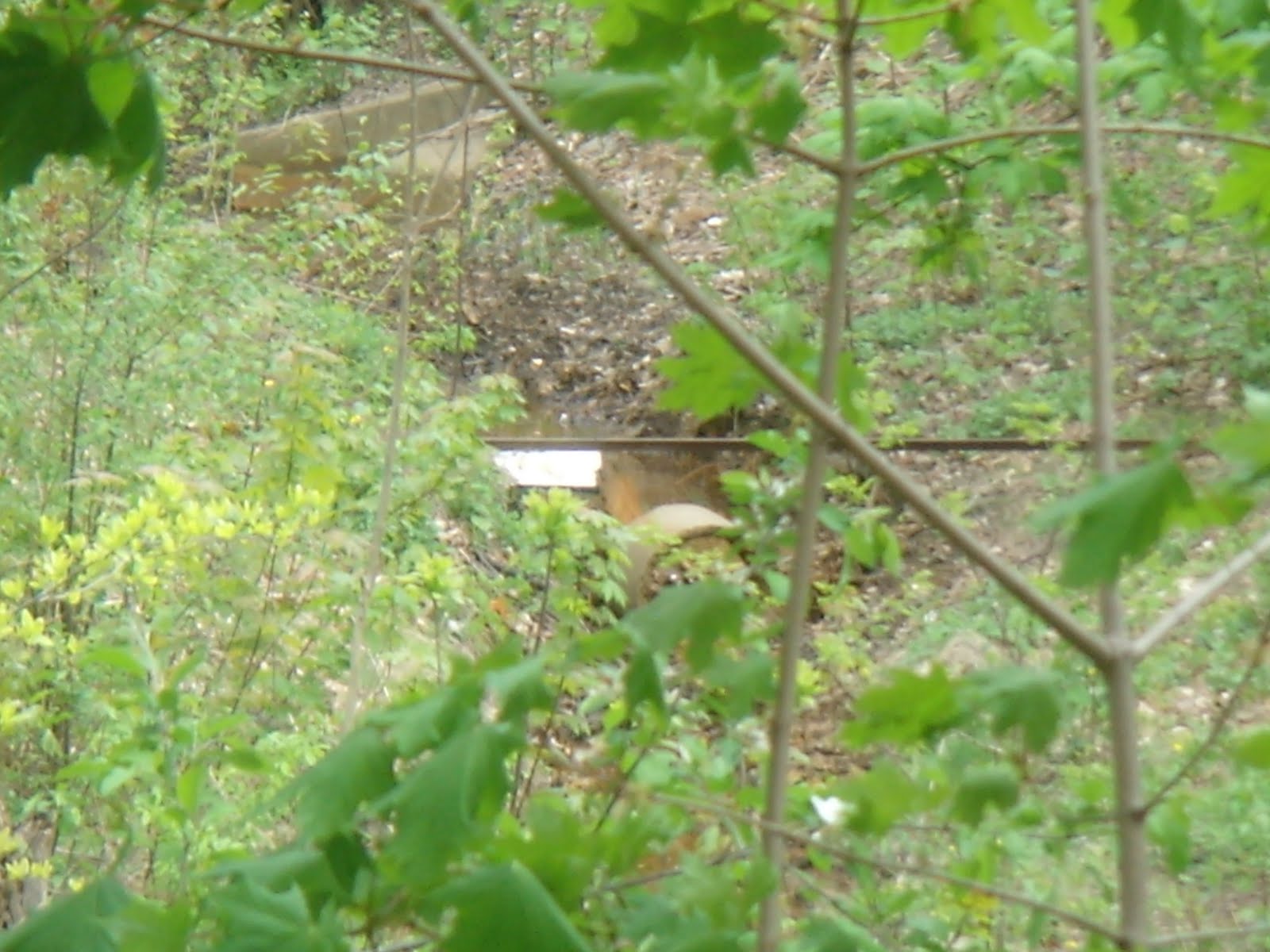
The small stream viewed from Main Street looking towards Broad Street. You can just see a concrete structure in the far distance (top left corner of picture) that seems to be where the stream emerges from below ground.

Another view of the small stream as viewed from the south side of Main Street.

There is a ravine surrounding this part of the stream with small trees and bushes.

The Kat Shack bar as seen from behind the supporting wall of MA-17 across Main Street near Terhune Park.

A better view of the brickwork supporting MA-17 on the south side of Main Street.

The face of MA-17 on the north side of Main Street.

The small stream viewed from the north side of Main Street looking towards Lake Lefferts.

The deep ravine on the north side of Main Street is heavily treed. Some trees are covered with vines. The foundation of the first building on Washington Street can be seen in the top left corner of this picture.

Many of the trees are growing on the steeply sloped ground and are in danger of falling into the ravine. In the foreground an uprooted tree has died and is leaning precariously on another. The small stream can be seen in the center with what looks like a makeshift retaining wall to the right of it.

Beautiful Terhune Park is right next door.

The small stream passes through the woods behind this Terhune Park playground.

The First Baptist Church and other fine architecture along Main Street can be seen from Terhune Park.
Thursday, April 22, 2010
African Americans in the Matawan Journal - 18 December 1931
Below is the fourth in my occasional series on African Americans mentioned in old editions of the Matawan Journal. Today's article, from a paper published nearly 80 years ago, shows how African Americans of our Township and Borough gathered together to fight against a proposal to segregate our local schools. They sent a strong message back to the Board of Education rejecting the construction of a separate school for their children, who were doing fine where they were.
Majority of Colored People Frown on Segregation Plan; Have No Desire For Separate School
PETITION HAD BEEN CIRCULATED
Seventy-five of Eighty Colored People at Meeting Express Satisfaction With Present School System.
A most exciting and interesting meeting was held by the colored men and women of Matawan Township and Borough in St. James' A. M. E. Zlon Church on Wednesday evening, to consider the segregating of the colored children of the district in a school building of their own, the personnel of which would be entirely colored.
A petition has been in circulation for some time past to which many names had been secured by Richard Lyons, who has been the prime mover inthe matter. In getting the signers to the petition a spirit of opposition was engendered and it was thought advisable to have the public meeting and thresh out the differences of those in favor of and against the segregating idea.
The meeting was presided over by the Rev. C C R Jones and the proposition was freely and openly discussed by the adherents of both sides, and resulted in many personalities.
The only question that those in favor of the scheme had was that it might be better for the children to have teachers of their own blood, that they might do better in their studies if guided by them. To this the opponents replied that Matawan had never had the question of segregation raised before; that there were politics in the deal; that certain men had been promised that if they helped elect this or that man to the office of school trustee, that a colored school would be constructed for them and managed by colored teachers and officials. Now, that those who had done the work required by their superiors, wanted their promises carried out by those making them, and they being either afraid or unwilling to stand up to their promises, had advised the present mode of procedure, with the assurances that they would abide by the decision of the majority of the colored fathers and mothers. The opposing element also stated that the present was no time to load further burdens of taxation on the people of the school district; that a lot, building, equipment, teachers, janitors, and other necessary expense would have to be borne by the taxpayer, and would cost probably $15,000 or $18,000 per year, which was all uncalled for, as the children were receiving an education in the public school of the township equal to their white associates and that colored graduates from the High School compared favorably with the white graduates as to points.
Those who spoke in favor of the division were A E Davis and Richard Lyons. Those who spoke in opposition were K P Lee, S C Towler, Mrs James Simmons, Myron Suydam, Sidney Butner, John Lucas, John Johnson, Mrs Martha Suydam, and the Rev R C C Jones.
At the close of the discussion the chair stated that a vote would be taken on the question "Does this assemblage favor a change in the matter of the education of the colored children of the Matawan school district?" A rising vote was taken and seventy-five were counted as against the proposition and five in favor of the change.
A motion prevailed that a committee be appointed to secure the names of those opposed to the segregation proposition, and that the petition be presented at the next meeting of the Board of Education, and that all who desire, appear before the Board and state their favor or objection to the proposition. The chairman appointed as such committee John Johnson, John Lucas, Sidney Burton, Samuel Harrison, S C Towler. This committee will meet tonight to formulate a plan of procedure, as they are just as determined to fight any change in the method of the education of their children, as those who favor the plan.
On Thursday night another meeting was called by those in favor of the change to be held at St Moriah Baptist Church, Cliffwood, where the subject was further discussed. The Rev Mr Cokeley was chosen as chairman, and after a lengthy discussion by all who cared to have anything to say, a rising vote was taken as to whether this meeting favored the separation of the children from the white school and resulted in thirty-six voting "no" and one voting "yes."
It is thought by the opposition that the question of segregation is practically dead, as those in favor number so few that should they go before the Board together with the large negative feeling that the Board of Education will dismiss the matter.
Source: Matawan Journal, 18 December 1931, front page, continued on p 6
Majority of Colored People Frown on Segregation Plan; Have No Desire For Separate School
PETITION HAD BEEN CIRCULATED
Seventy-five of Eighty Colored People at Meeting Express Satisfaction With Present School System.
A most exciting and interesting meeting was held by the colored men and women of Matawan Township and Borough in St. James' A. M. E. Zlon Church on Wednesday evening, to consider the segregating of the colored children of the district in a school building of their own, the personnel of which would be entirely colored.
A petition has been in circulation for some time past to which many names had been secured by Richard Lyons, who has been the prime mover in
Friday, March 26, 2010
African Americans in the Matawan Journal - 29 March 1935
Below is the second in my occasional series on African Americans mentioned in old articles in the Matawan Journal. My procedure is to publish the first article I find mentioning African Americans in a Matawan Journal dated 50, 75, or 100 years ago.
I'll let you decide whether this article about a performance in nearby Laurence Harbor by an all-colored cast of colored performers from the Second Baptist Church of Matawan, published in a Journal article written 75 years ago this week, leaves you with a more positive or negative impression.
Laurence Harbor P. - T. A. To Sponsor Performance
An entertainment will be held at the Laurence Harbor school tonight under the auspices of the Parent-Teacher Association group of the school. It will consist of a musical demonstration of negro dialect and spiritual songs rendered by an all-colored cast of colored performers under the direction of the Rev. William J. Hutchinscn, pastor, of the Second Baptist Church of Matawan. The Rev. Mr. Hutchinson is also a member of the local P.-T. A.
Proceeds realized on the affair will be turned over to the local school to pay for reference books recently purchased for the use of the children.
Source: The Matawan Journal, 29 March 1935, p. 9 col. 4.
I'll let you decide whether this article about a performance in nearby Laurence Harbor by an all-colored cast of colored performers from the Second Baptist Church of Matawan, published in a Journal article written 75 years ago this week, leaves you with a more positive or negative impression.
Laurence Harbor P. - T. A. To Sponsor Performance
An entertainment will be held at the Laurence Harbor school tonight under the auspices of the Parent-Teacher Association group of the school. It will consist of a musical demonstration of negro dialect and spiritual songs rendered by an all-colored cast of colored performers under the direction of the Rev. William J. Hutchinscn, pastor, of the Second Baptist Church of Matawan. The Rev. Mr. Hutchinson is also a member of the local P.-T. A.
Proceeds realized on the affair will be turned over to the local school to pay for reference books recently purchased for the use of the children.
Source: The Matawan Journal, 29 March 1935, p. 9 col. 4.
Sunday, February 7, 2010
Fifty Years of Ministry at First Baptist Church (1903-1952)
Below is a summary of fifty years of ministry (1903 - 1952) at the First Baptist Church in Matawan, based in large part on First Baptist of Matawan: A Constant Testimony, by Reverend Lewis W Kisenwether, Jr. (Matawan: Matbap, 2000). References are also made to The Matawan Journal and US census records.
The Reverend Samuel Bower began his ministry at Matawan in October 1903. The Matawan Journal said he was exceedingly popular, officiating at over 80 weddings and 244 funerals. "He was a ready talker and always had a funny story or more to spring on his audiences." He joined the Masonic Lodge and served as its chaplain for several years.
Major renovations included new pews and a center doorway leading to the center aisle of the meetingplace. Maude (McChesney) Banke began more than a half century of service as church organist in 1911. The church's association with the local Boy Scouts began in 1913.
Reverend Bower was 47 years old in the 1910 Federal Census, which showed him living with a wife and two children at 223 Main Street in Matawan. The Reverend was born in Pennsylvania to a father born in England and a mother from Pennsylvania. The Reverend was listed as a clergyman. His wife India M Bower was a year younger than he and was also born in Pennsylvania. A daughter Irene, 22 and son Samuel, 10, were both born in Pennsylvania. The Reverend and his wife had been married 16 years at the time.
Reverend Bower submitted his letter of resignation on 20 December 1914 to accept a call to the Lee Street Memorial Church in Baltimore, Maryland. At first the church rejected his letter, but eventually accepted it when a special committee of three deacons couldn't convince him to reconsider. His farewell service, which took place on 17 January 1915, was covered on the front page of The Matawan Journal (21 January 1915 page 1 column 1). (pp 34-38)
The Reverend Luther Latham Holmes began his ministry at Matawan on 16 May 1915, coming from a previous parish at Norwich, Connecticut. The church gained 77 new members during his tenure, 65 by baptism. The Ladies Aid Society published a cookbook in 1915. The church had an electrical system installed in 1916. (pp 38-39)
Reverend Holmes was 37 years old and living in Parkersburg, West Virginia in the 1920 Federal Census. He was a preacher at a Baptist church. The Reverend was living with his wife Eliza M Holmes, age 30, also of Massachusetts. Reverend Holmes was a clergyman at a church in Georgia, Vermont (Franklin Co) in the 1910 Federal Census.
The Reverend William W Ludwig was born in New York State about 1865. He graduated Crozier Seminary. Believing strongly in home mission, the Reverend served three years in Minnesota before becoming a pastor. He and his wife Sadie had three sons. They lost two sons just before coming to Matawan, one in an airplane accident in England during the First World War (1918) and the second due to illness while studying for the ministry at Colgate University (1919). The third son, a businessman in Englewood, occasionally preached at Matawan in his capacity as executive director of Pioneer Youth of America.
The Reverend Ludwig was called in December 1919 while pastor at the Baptist church in Borough Park, Brooklyn, New York, according to The Matawan Journal (18 December 1919 page 5 column 3) and installed at Matawan on 4 January 1920. Besides the three sets of twins in Sunday School, the most notable occurrence during his decade of service was in October 1927, when the Board of Trustees took action to reverse a dip in church membership. The trustees resolved to have services start and end on time, reduce the amount of time worshipers had to stand, improve the quality of scripture readings, dedicate a service to hymn singing once a month, and increase overall lay involvement. While not a direct criticism of Reverend Ludwig, whom the trustees described as overworked, suggestions that scripture be read without commentary by the Pastor and that services "start and stop on time" can't help but give the impression that the Trustees were issuing an extraordinary, if subtle corrective.
During his tenure, the Ladies Aid Society purchased and installed nine stained glass windows. Two of the windows were designed by Rev Ludwig himself, including one with a patriotic theme dedicated on Memorial Day (28 May) 1922. The window, made by Sharp Brothers of Newark, shows an American flag emerging from the clouds of war, with the mottos Our God is marching on and Lest We Forget emblazoned in the glass.
Reverend Ludwig addressed a meeting of the Monmouth Baptist Ministers Association at the First Baptist Church of Asbury Park in 1927 on his many years in ministry. The Reverend retired on 26 October 1930, having served 37 years in ministry. According to The Matawan Journal the following day (31 October 1931 page 1 columns 4-5), the Reverend W H Dilts of First Presbyterian church and the Reverend Edward Mount of the First Methodist Episcopal church attended the festivities with their wives. The three churches planned a union service of song the following Sunday evening as a final farewell to the Reverend and his wife. (pp 39-40)
First Baptist had a vacancy in the pulpit for about six weeks. During that time, a general notice of worship services appeared in The Matawan Journal through 5 December 1930 (page 8 column 6). Joint Thanksgiving services were held at the Presbyterian church in 1930, with the Presbyterian pastor officiating, according to The Matawan Journal (28 November 1930 page 1 column 7).
Reverend Ludwig was 45 years old in the 1910 Federal Census and living in Brooklyn, New York. He was listed as a clergyman at a church. He was born in New York State to German parents. His wife Sadie was 39 years old, also of New York. They had four children - Everett (14, Minnesota), Lloyd (13, New Jersey), William (12, New Jersey), and Kenneth (11, New York).
The Reverend Carl H Koeker, Jr, of Ohio, is listed as preaching at both morning and evening services at the First Baptist Church in the 12 December 1930 issue of The Matawan Journal (page 5 column 8). When the Monmouth Baptist Association met in Keyport on 5 January 1931, there was no mention in the Matawan Journal article covering the event (9 January 1931 page 6 column 5) of a pastor from Matawan attending. Reverend Koeker, pastor of First Baptist, appears in an article in the Matawan Journal of 27 March 1931 (page 1 column 8). The article features his speech to the monthly meeting of the area's Council of Religious Education. His topic was "The Land of the Bible," in which he offered his observations from a personal trip to Palestine.
Reverend Koeker began a number of groups focused on mission and youth, including a guild for girls and a mission circle, as well as a Vacation Bible School, which was founded on 15 June 1931. He served the Monmouth Baptist Association in leadership roles. He also taught courses on the Old Testament and local church organization at a NJ Baptist Convention-related young people's assembly held at the Peddie School in Hightstown.
Reverend Koeker brought in 62 new members, 44 by baptism. The Reverend and his wife Grayce had a son during their tenure at Matawan. On 15 September 1936, Reverend Koeker submitted his letter of resignation to accept a call to mission in Sacramento, California. (pp 45-48)
The Reverend Garrett S Detwiler graduated from Eastern Baptist Theological Seminary in St David's, Pennsylvania in 1933. He was ordained at the First Baptist Church of Baptistown, New Jersey, where he served through the end of 1936.
Reverend Detwiler began his ministry at Matawan on 1 January 1937. He introduced the concept of a weekly church bulletin at the Easter service later that year. He brought membership to 340 by 1943.
The Reverend took a leave of absence after enlisting in the US Army to serve in the Second World War in October 1943. He accepted a commission as a first lieutenant and reported to Chaplains School at Harvard University in March 1944. The Reverend had the occasion to visit one of the Nazi concentration camps, something he described to his wife in a letter home. Much of that letter witnessing to the horror of the camps was published in The Sunday Asbury Park Press in a 4-column article on 13 May 1945. Reverend Detwiler returned to his post at Matawan at the end of the war.
The church received the gift of another stained glass window from the Ladies Aid Society. This one, of the Baptism of Jesus, was given in memory of two deceased presidents of the society and in honor of one who was still living.
The church celebrated its centennial in 1950. The History of the First Baptist Church was written by Franklin S Thompson as a centennial publication.
Reverend Detwiler left ministry at Matawan in September 1952 to become pastor of the Memorial Baptist Church in Salem, New Jersey. (pp 48-61)
The Reverend Samuel Bower began his ministry at Matawan in October 1903. The Matawan Journal said he was exceedingly popular, officiating at over 80 weddings and 244 funerals. "He was a ready talker and always had a funny story or more to spring on his audiences." He joined the Masonic Lodge and served as its chaplain for several years.
Major renovations included new pews and a center doorway leading to the center aisle of the meetingplace. Maude (McChesney) Banke began more than a half century of service as church organist in 1911. The church's association with the local Boy Scouts began in 1913.
Reverend Bower was 47 years old in the 1910 Federal Census, which showed him living with a wife and two children at 223 Main Street in Matawan. The Reverend was born in Pennsylvania to a father born in England and a mother from Pennsylvania. The Reverend was listed as a clergyman. His wife India M Bower was a year younger than he and was also born in Pennsylvania. A daughter Irene, 22 and son Samuel, 10, were both born in Pennsylvania. The Reverend and his wife had been married 16 years at the time.
Reverend Bower submitted his letter of resignation on 20 December 1914 to accept a call to the Lee Street Memorial Church in Baltimore, Maryland. At first the church rejected his letter, but eventually accepted it when a special committee of three deacons couldn't convince him to reconsider. His farewell service, which took place on 17 January 1915, was covered on the front page of The Matawan Journal (21 January 1915 page 1 column 1). (pp 34-38)
The Reverend Luther Latham Holmes began his ministry at Matawan on 16 May 1915, coming from a previous parish at Norwich, Connecticut. The church gained 77 new members during his tenure, 65 by baptism. The Ladies Aid Society published a cookbook in 1915. The church had an electrical system installed in 1916. (pp 38-39)
Reverend Holmes was 37 years old and living in Parkersburg, West Virginia in the 1920 Federal Census. He was a preacher at a Baptist church. The Reverend was living with his wife Eliza M Holmes, age 30, also of Massachusetts. Reverend Holmes was a clergyman at a church in Georgia, Vermont (Franklin Co) in the 1910 Federal Census.
The Reverend William W Ludwig was born in New York State about 1865. He graduated Crozier Seminary. Believing strongly in home mission, the Reverend served three years in Minnesota before becoming a pastor. He and his wife Sadie had three sons. They lost two sons just before coming to Matawan, one in an airplane accident in England during the First World War (1918) and the second due to illness while studying for the ministry at Colgate University (1919). The third son, a businessman in Englewood, occasionally preached at Matawan in his capacity as executive director of Pioneer Youth of America.
The Reverend Ludwig was called in December 1919 while pastor at the Baptist church in Borough Park, Brooklyn, New York, according to The Matawan Journal (18 December 1919 page 5 column 3) and installed at Matawan on 4 January 1920. Besides the three sets of twins in Sunday School, the most notable occurrence during his decade of service was in October 1927, when the Board of Trustees took action to reverse a dip in church membership. The trustees resolved to have services start and end on time, reduce the amount of time worshipers had to stand, improve the quality of scripture readings, dedicate a service to hymn singing once a month, and increase overall lay involvement. While not a direct criticism of Reverend Ludwig, whom the trustees described as overworked, suggestions that scripture be read without commentary by the Pastor and that services "start and stop on time" can't help but give the impression that the Trustees were issuing an extraordinary, if subtle corrective.
During his tenure, the Ladies Aid Society purchased and installed nine stained glass windows. Two of the windows were designed by Rev Ludwig himself, including one with a patriotic theme dedicated on Memorial Day (28 May) 1922. The window, made by Sharp Brothers of Newark, shows an American flag emerging from the clouds of war, with the mottos Our God is marching on and Lest We Forget emblazoned in the glass.
Reverend Ludwig addressed a meeting of the Monmouth Baptist Ministers Association at the First Baptist Church of Asbury Park in 1927 on his many years in ministry. The Reverend retired on 26 October 1930, having served 37 years in ministry. According to The Matawan Journal the following day (31 October 1931 page 1 columns 4-5), the Reverend W H Dilts of First Presbyterian church and the Reverend Edward Mount of the First Methodist Episcopal church attended the festivities with their wives. The three churches planned a union service of song the following Sunday evening as a final farewell to the Reverend and his wife. (pp 39-40)
First Baptist had a vacancy in the pulpit for about six weeks. During that time, a general notice of worship services appeared in The Matawan Journal through 5 December 1930 (page 8 column 6). Joint Thanksgiving services were held at the Presbyterian church in 1930, with the Presbyterian pastor officiating, according to The Matawan Journal (28 November 1930 page 1 column 7).
Reverend Ludwig was 45 years old in the 1910 Federal Census and living in Brooklyn, New York. He was listed as a clergyman at a church. He was born in New York State to German parents. His wife Sadie was 39 years old, also of New York. They had four children - Everett (14, Minnesota), Lloyd (13, New Jersey), William (12, New Jersey), and Kenneth (11, New York).
The Reverend Carl H Koeker, Jr, of Ohio, is listed as preaching at both morning and evening services at the First Baptist Church in the 12 December 1930 issue of The Matawan Journal (page 5 column 8). When the Monmouth Baptist Association met in Keyport on 5 January 1931, there was no mention in the Matawan Journal article covering the event (9 January 1931 page 6 column 5) of a pastor from Matawan attending. Reverend Koeker, pastor of First Baptist, appears in an article in the Matawan Journal of 27 March 1931 (page 1 column 8). The article features his speech to the monthly meeting of the area's Council of Religious Education. His topic was "The Land of the Bible," in which he offered his observations from a personal trip to Palestine.
Reverend Koeker began a number of groups focused on mission and youth, including a guild for girls and a mission circle, as well as a Vacation Bible School, which was founded on 15 June 1931. He served the Monmouth Baptist Association in leadership roles. He also taught courses on the Old Testament and local church organization at a NJ Baptist Convention-related young people's assembly held at the Peddie School in Hightstown.
Reverend Koeker brought in 62 new members, 44 by baptism. The Reverend and his wife Grayce had a son during their tenure at Matawan. On 15 September 1936, Reverend Koeker submitted his letter of resignation to accept a call to mission in Sacramento, California. (pp 45-48)
The Reverend Garrett S Detwiler graduated from Eastern Baptist Theological Seminary in St David's, Pennsylvania in 1933. He was ordained at the First Baptist Church of Baptistown, New Jersey, where he served through the end of 1936.
Reverend Detwiler began his ministry at Matawan on 1 January 1937. He introduced the concept of a weekly church bulletin at the Easter service later that year. He brought membership to 340 by 1943.
The Reverend took a leave of absence after enlisting in the US Army to serve in the Second World War in October 1943. He accepted a commission as a first lieutenant and reported to Chaplains School at Harvard University in March 1944. The Reverend had the occasion to visit one of the Nazi concentration camps, something he described to his wife in a letter home. Much of that letter witnessing to the horror of the camps was published in The Sunday Asbury Park Press in a 4-column article on 13 May 1945. Reverend Detwiler returned to his post at Matawan at the end of the war.
The church received the gift of another stained glass window from the Ladies Aid Society. This one, of the Baptism of Jesus, was given in memory of two deceased presidents of the society and in honor of one who was still living.
The church celebrated its centennial in 1950. The History of the First Baptist Church was written by Franklin S Thompson as a centennial publication.
Reverend Detwiler left ministry at Matawan in September 1952 to become pastor of the Memorial Baptist Church in Salem, New Jersey. (pp 48-61)
Friday, January 29, 2010
Aberdeen's Middletown Origins

Above is the pertinent detail from an historic New Jersey state map available at Rutgers University's Mapmaker website, while below are several related entries from the Gazetteer of the State of New Jersey, by Thomas F. Gordon. Both items were originally published in 1834. The Gazetteer, reprinted in 1973, is available at the Matawan Aberdeen Public Library at NJ 974.903 Go. It is also available in a scanned version (with some OCR errors) at Internet Archive.
Middletown t-ship, Monmouth co., bounded N. by Raritan bay and Sandy Hook, E. by the Atlantic ocean, S. by Shrewsbury t-ship, and W. by South Amboy t-ship, Middlesex co. Centrally distant N.E. from Freehold 10 miles; greatest length E. and W. 16, breadth N. and S. 10 miles; area, 50, 000 acres; surface, on the east and centre, hilly, elsewhere, level; soil, loam, sand, and clay, not naturally of the first quality, but highly improved, in places, by the use of marl, which has become common. Sandy Hook bay runs south into the t-ship from the Raritan, and is bounded on the S. W. by the promontory of the highlands of Nevisink, and on the E. by the sand beach, forming Sandy Hook, running 6 miles north from Shrewsbury Inlet; upon the north point of which stands Sandy Hook Light-house. The t-ship is drained on the S. E., S. and S. W. by Swimming and Nevisink rivers; on the N. W. by Middletown creek ; N. by Waycake, and N. E. by Watson's and Shoal Harbour creeks. Middletown, Middletown Point, Baptisttown, or Holmdel and Mount Pleasant are villages, the two first post-towns, of the t-ship. Population in 1830, 5128. In 1832 the t-ship contained about 1000 taxables, 277 householders, whose ratables did not exceed $30; 169 single men, 27 stores, 5 saw mills, 13 run of stones for grinding grain, 1 fulling mill, 36 tan vats, 11 distilleries, 956 horses and mules, and 2286 neat cattle, above 3 years of age; and paid state and county taxes, $2620 20. Good lands will bring in this t-ship an average price of $60 the acre.
In 1682 Middletown contained about 100 families; several thousand acres had been collected for the town, and many thousand for out-plantations. John Browne, Richard Hartshorne, and Nicholas Davis, had well improved settlements here; and a court of sessions was holden twice or thrice a year, for Middletown, Piscataway and their jurisdictions.
Middletown, post-town of Middletown t-ship, Monmouth co., 13 miles N. E. from Freehold, 56 from Trenton, and 221 from W. C, situate in a rolling and fertile country, based on marl; contains an Episcopal, a Dutch Reformed, and a Baptist church, 2 stores, 2 taverns, and from 20 to 25 dwellings, among which, there are several very neat and commodious.
Middletown Point, port of delivery of Perth Amboy district, and post-town of Middletown t-ship, Monmouth co., upon Middletown creek, about 3 miles from the Raritan bay, 11 miles N. of Freehold, 47 N. E. from Trenton, and 213 from W. C; lies on a bank elevated about 50 feet above the stream, fronting a marsh on the opposite side; contains a Presbyterian church, from 75 to 100 dwellings, many of which are very good buildings, 8 or 10 stores, 4 taverns, and a grist mill. This is the market of an extensive country, and large quantities of pork, rye, corn, cord wood, and garden truck, are thence sent to New York. The soil immediately around the town is sandy. There is a bank here, incorporated in 1830, with a capital of $50,000, of which $10,000 only were paid in, in 1833.
Sunday, December 20, 2009
A 1904 History of Baptists in Keyport and Matawan
A History of Baptists in New Jersey, by T S Griffiths, published by Barr Press Publishing Company of Hightstown, NJ in 1904, is available at Internet Archive. The online text is obviously scanned and so has a number of common OCR errors.
Below, I've attempted to fix the errors in the text of the book's chapter 24, which talks about the history of Baptists in Keyport and Matawan.
CHAPTER XXIV.
KEYPORT AND MATAWAN.
Keyport is on the shore of the Raritan Bay in Monmouth county, six miles from Middletown village. At the time of the organization of the Baptist church, in 1840, it was a small village of late origin. The pastors of Middletown, Holmdel and Jacksonville had appointments there for several years before the Baptist church was formed. Thus Baptists increased until their number justified an organization of a Baptist church. Rev. J. M. Carpenter of Jacksonville, first made a regular appointment. Mr. S. Sproul, a licentiate of Middletown, a resident at Keyport was active in maintaining social devotional meetings there. Providentially, Rev. F. Ketchum, an evangelist came to Middletown. Hundreds of converts were a result of the meeting.
A proposal to found a branch at Keyport was rejected and a Baptist church of eleven constituents was organized in August 1840. On the same day, Mr. Ketchum baptized twelve converts into its fellowship. The Board of the State Convention appointed Mr. Jackson Smith, a licentiate of Middletown church its missionary at Keyport. Mr. Smith gave up the field and in February 1841, the Board was asked to appoint Mr. William V. Wilson to Keyport. They did so. Mr. Wilson was ordained in May 1841. Rev. Mr. Wilson has lived and his ministry has been exclusively in Monmouth county. New Jersey, where he has been pastor of three Baptist churches, Keyport, Navesink and Port Monmouth, closing his pastoral work January 1, 1892, of fifty-one years, being past his eightieth year and pastor of the third church to which he ministered thirty-eight years. These fifty years of pastoral labor within so narrow a circuit is an indication of the worth of the man and of his influence. Himself financially able, churches, missions and education were quietly uplifted from depths.
A meeting house was built at Keyport the first year of Mr. Wilson's pastorate. Originally, Keyport church had been constituted as the third church of Middletown. Holmdel being the second Middletown. But in 1850, the name was changed to first Baptist church of Keyport. Soon after settling at Keyport, Pastor Wilson made a regular appointment at Middletown point, (now Matawan). He also administered the Lord's Supper in school houses for the convenience of the Baptists scattered in the (now Marlboro township). In 1850, Mr. Wilson secured the erection of a very neat and commodius house of worship in Matawan. Mr. Wilson resigned in August 1853, after being pastor more than twelve years. The growth of the church had been constant and the increase was such that a larger and better church edifice was necessary and measures were taken to build it.
In June 1854, Rev. J. Q. Adams entered the pastorate. In little more than a year, he gave up his charge. Mr. Wilson was called but declined to return. After a long interval in the pastorate. Rev. F. A. Slater accepted the pastoral charge in the latter part of 1856. The resignation of Mr. Wilson delayed the plans for a new house of worship, but earnest plans were adopted at the coming of Mr. Slater and the meeting house was nearly finished when he resigned in 1862. Next December, Rev. A. P. Greaves became pastor; the new church edifice was dedicated while he was ministering to the church. His resignation took effect in 1864.
On the next June 1865, Rev. F. F. Cailhopper was called and soon after settled as pastor. His stay was but four years. A long interval occurred in the pastoral office and the church prospered as much as the conditions allowed. Rev. J. K. Manning entered the pastorate in October, 1870; held the longest pastoral charge the church enjoyed. Resigning in 1883, about thirteen years. The succession of pastors since him has been: S. K. Dexter, 1883-89; J. D. Crumley, 1890-99. Up to 1900, the church has had nine pastors, two of whom remained twelve and more years each. Several members have been licensed to preach. The church has not been disturbed with discord. Deacon Thomas Burrowes has been an efficient co-worker with the church and the pastors. Equally active in all missions in the vicinity of the church and the Association missions. One church, Matawan has been colonized from Keyport church.
Although Matawan Baptist church is closely related to Keyport Baptist church, Baptist interests there antidated the beginnings of Baptist movements at Keyport. Before 1830, Pastor Roberts of first Middletown church preached in the house of Mrs. Elizabeth Bent at Matawan. Pastors J. M. Carpenter and J. Goble of Jacksonville also preached in Matawan. Mr. Carpenter lived in Matawan two years. Rev. William V. Wilson, while pastor at Keyport preached regularly at Matawan for nearly nine years. Converts there were baptized into the membership of Keyport church. Of the thirty-two Baptists who constituted the Matawan Baptist church on October 22nd, 1850, twenty were from Keyport and a church edifice was built for them by Pastor Wilson of Keyport the same year. It would not surprise those who know Mr. Wilson if they learned that he was the largest donor for its cost.
The Matawan church chose Rev. Job Gaskill of Columbus for their pastor. Mr. Gaskill was a missionary of the Board of the State Convention at work about Matawan. Mr. Gaskill was one of the most devotedly godly men and Mrs. Gaskill one of the most active and earnest among Christian women. Both of them had ample private means and relieved the church of wholly caring for them. Mr. Gaskill was a very frail man, though he had immense courage. Only a few months sufficed to lay him aside and he was compelled to return home Additions to the church greatly strengthened it. Mr. D. F. Twiss followed as pastor. But like to his predecessor, he was very frail. Sad afflictions befell him. Death claimed his four children. Disease preyed upon his companion and hemhorrages warned him of his own early death and in October 1853, he resigned to the grief of the church and community. He died June 30th, 1857, and entered into his reward.
In June 1854, Rev. J. W. Crumb became pastor. For four years he wholly served the church. In the last year of his charge a great calamity befell the church: their church edifice was burned in February 1858. The insurance policy had expired days before and the loss was total. The loss of the pastor and the burning of their house of worship was a concurrence of disappointments, nearly fatal to the church. But a conference of neighboring pastors pledged them help in their need. Pastor Crumb closed his labors at Matawan in May, 1858. A hall was rented and a "permanent supply" obtained. Pastor Slater of Keyport assured them of an afternoon Lord's Day service till they had a pastor.
Rev. J. E. Barnes settled as pastor in November 1859, remaining two and more years. These years had ample returns. Large con- gregations waited on his ministry and his executive gifts wrought to complete a new house of worship. A graduate, Mr. R. G. Farley, came within a year and was ordained. In the next four years, their new church edifice was paid for. The hardships of short and new pastorships and of the fire, caused a decline of the membership and of the financial and spiritual strength. However, Rev. F. A. Slater entered the pastorate in October 1866. In a few years, harvests of converts and renewed vigor confirmed the choice of the pastor. Mr. Slater was pastor for twenty-three years. Resigning in September 1889, on account of increasing infirmities, suffered several years since in a railroad accident.
In January 1890, Rev. C. L. Percy became pastor and closed his charge in October 1894. Two members of the church (women) sailed in 1892, for mission work in India. Pastor H. J. Whalen settled in January 1895 and resigned in January 1899. On the next June, Rev. J. Y. Irving accepted a call to be pastor. While the church has hopeful prospects, the commercial and business future of the town does not indicate an extensive growth. If William V. Wilson is included as pastor, the church has had ten pastors. Two houses of worship have been in use. The first built in 1850 and burned in 1858; another now in use. There is not a published statement of members having been licensed to preach and yet, two female members are in India as missionaries.
Below, I've attempted to fix the errors in the text of the book's chapter 24, which talks about the history of Baptists in Keyport and Matawan.
CHAPTER XXIV.
KEYPORT AND MATAWAN.
Keyport is on the shore of the Raritan Bay in Monmouth county, six miles from Middletown village. At the time of the organization of the Baptist church, in 1840, it was a small village of late origin. The pastors of Middletown, Holmdel and Jacksonville had appointments there for several years before the Baptist church was formed. Thus Baptists increased until their number justified an organization of a Baptist church. Rev. J. M. Carpenter of Jacksonville, first made a regular appointment. Mr. S. Sproul, a licentiate of Middletown, a resident at Keyport was active in maintaining social devotional meetings there. Providentially, Rev. F. Ketchum, an evangelist came to Middletown. Hundreds of converts were a result of the meeting.
A proposal to found a branch at Keyport was rejected and a Baptist church of eleven constituents was organized in August 1840. On the same day, Mr. Ketchum baptized twelve converts into its fellowship. The Board of the State Convention appointed Mr. Jackson Smith, a licentiate of Middletown church its missionary at Keyport. Mr. Smith gave up the field and in February 1841, the Board was asked to appoint Mr. William V. Wilson to Keyport. They did so. Mr. Wilson was ordained in May 1841. Rev. Mr. Wilson has lived and his ministry has been exclusively in Monmouth county. New Jersey, where he has been pastor of three Baptist churches, Keyport, Navesink and Port Monmouth, closing his pastoral work January 1, 1892, of fifty-one years, being past his eightieth year and pastor of the third church to which he ministered thirty-eight years. These fifty years of pastoral labor within so narrow a circuit is an indication of the worth of the man and of his influence. Himself financially able, churches, missions and education were quietly uplifted from depths.
A meeting house was built at Keyport the first year of Mr. Wilson's pastorate. Originally, Keyport church had been constituted as the third church of Middletown. Holmdel being the second Middletown. But in 1850, the name was changed to first Baptist church of Keyport. Soon after settling at Keyport, Pastor Wilson made a regular appointment at Middletown point, (now Matawan). He also administered the Lord's Supper in school houses for the convenience of the Baptists scattered in the (now Marlboro township). In 1850, Mr. Wilson secured the erection of a very neat and commodius house of worship in Matawan. Mr. Wilson resigned in August 1853, after being pastor more than twelve years. The growth of the church had been constant and the increase was such that a larger and better church edifice was necessary and measures were taken to build it.
In June 1854, Rev. J. Q. Adams entered the pastorate. In little more than a year, he gave up his charge. Mr. Wilson was called but declined to return. After a long interval in the pastorate. Rev. F. A. Slater accepted the pastoral charge in the latter part of 1856. The resignation of Mr. Wilson delayed the plans for a new house of worship, but earnest plans were adopted at the coming of Mr. Slater and the meeting house was nearly finished when he resigned in 1862. Next December, Rev. A. P. Greaves became pastor; the new church edifice was dedicated while he was ministering to the church. His resignation took effect in 1864.
On the next June 1865, Rev. F. F. Cailhopper was called and soon after settled as pastor. His stay was but four years. A long interval occurred in the pastoral office and the church prospered as much as the conditions allowed. Rev. J. K. Manning entered the pastorate in October, 1870; held the longest pastoral charge the church enjoyed. Resigning in 1883, about thirteen years. The succession of pastors since him has been: S. K. Dexter, 1883-89; J. D. Crumley, 1890-99. Up to 1900, the church has had nine pastors, two of whom remained twelve and more years each. Several members have been licensed to preach. The church has not been disturbed with discord. Deacon Thomas Burrowes has been an efficient co-worker with the church and the pastors. Equally active in all missions in the vicinity of the church and the Association missions. One church, Matawan has been colonized from Keyport church.
Although Matawan Baptist church is closely related to Keyport Baptist church, Baptist interests there antidated the beginnings of Baptist movements at Keyport. Before 1830, Pastor Roberts of first Middletown church preached in the house of Mrs. Elizabeth Bent at Matawan. Pastors J. M. Carpenter and J. Goble of Jacksonville also preached in Matawan. Mr. Carpenter lived in Matawan two years. Rev. William V. Wilson, while pastor at Keyport preached regularly at Matawan for nearly nine years. Converts there were baptized into the membership of Keyport church. Of the thirty-two Baptists who constituted the Matawan Baptist church on October 22nd, 1850, twenty were from Keyport and a church edifice was built for them by Pastor Wilson of Keyport the same year. It would not surprise those who know Mr. Wilson if they learned that he was the largest donor for its cost.
The Matawan church chose Rev. Job Gaskill of Columbus for their pastor. Mr. Gaskill was a missionary of the Board of the State Convention at work about Matawan. Mr. Gaskill was one of the most devotedly godly men and Mrs. Gaskill one of the most active and earnest among Christian women. Both of them had ample private means and relieved the church of wholly caring for them. Mr. Gaskill was a very frail man, though he had immense courage. Only a few months sufficed to lay him aside and he was compelled to return home Additions to the church greatly strengthened it. Mr. D. F. Twiss followed as pastor. But like to his predecessor, he was very frail. Sad afflictions befell him. Death claimed his four children. Disease preyed upon his companion and hemhorrages warned him of his own early death and in October 1853, he resigned to the grief of the church and community. He died June 30th, 1857, and entered into his reward.
In June 1854, Rev. J. W. Crumb became pastor. For four years he wholly served the church. In the last year of his charge a great calamity befell the church: their church edifice was burned in February 1858. The insurance policy had expired days before and the loss was total. The loss of the pastor and the burning of their house of worship was a concurrence of disappointments, nearly fatal to the church. But a conference of neighboring pastors pledged them help in their need. Pastor Crumb closed his labors at Matawan in May, 1858. A hall was rented and a "permanent supply" obtained. Pastor Slater of Keyport assured them of an afternoon Lord's Day service till they had a pastor.
Rev. J. E. Barnes settled as pastor in November 1859, remaining two and more years. These years had ample returns. Large con- gregations waited on his ministry and his executive gifts wrought to complete a new house of worship. A graduate, Mr. R. G. Farley, came within a year and was ordained. In the next four years, their new church edifice was paid for. The hardships of short and new pastorships and of the fire, caused a decline of the membership and of the financial and spiritual strength. However, Rev. F. A. Slater entered the pastorate in October 1866. In a few years, harvests of converts and renewed vigor confirmed the choice of the pastor. Mr. Slater was pastor for twenty-three years. Resigning in September 1889, on account of increasing infirmities, suffered several years since in a railroad accident.
In January 1890, Rev. C. L. Percy became pastor and closed his charge in October 1894. Two members of the church (women) sailed in 1892, for mission work in India. Pastor H. J. Whalen settled in January 1895 and resigned in January 1899. On the next June, Rev. J. Y. Irving accepted a call to be pastor. While the church has hopeful prospects, the commercial and business future of the town does not indicate an extensive growth. If William V. Wilson is included as pastor, the church has had ten pastors. Two houses of worship have been in use. The first built in 1850 and burned in 1858; another now in use. There is not a published statement of members having been licensed to preach and yet, two female members are in India as missionaries.
Subscribe to:
Posts (Atom)