A blog about living in Aberdeen, New Jersey.

Showing posts with label NJ government. Show all posts

Sunday, August 14, 2016

History: Free Public High Schools in New Jersey

High schools in New Jersey started in the big cities -- Newark in 1836, and Trenton in 1842. Unfortunately, each local district established its own approach to post-common school education, yielding little agreement on what a high school might teach, or even whether a particular school district wanted to provide education beyond grammar school. Many communities didn't want to pay higher taxes just to fund a "poor man's academy", so little was done outside of the big cities to provide free education past the eighth grade.
The system of free public schools in New Jersey is based on the Free School Law of 1871. About fifty years earlier, the State School Fund had been an effort to help townships educate the poor. Between 1817 and 1871, the state abolished pauper schools, tuition payments, and the funding of sectarian schools and gave us school districts, local superintendents of schools, school boards, state tax education apportionments, and, of course, the beginnings of local school taxes.


In 1905, State Superintendent of Schools Charles J Baxter sent a letter to local school districts, pointing out that they had a constitutional mandate to provide free education to students up to and including the age of eighteen under the Free School Law of 1871. In the letter, Baxter told districts this could be accomplished either by operating a high school within an individual district or by making arrangements with a nearby district to accept their students. Baxter threatened to withhold the state school aid apportionment of any district which failed to comply.

Monmouth County Schools Superintendent John Enright tested eighth grade graduates of Matawan and Raritan townships and found five Matawan twp graduates eligible to study in high school. "These graduates have a high school course to finish before they are graduates from the school. They are simply leaving the grammar school department to undertake the studies of the high school department.The granting of diplomas this time is something new and an incentive for the younger scholars to continue along and work hard to obtain them. This marks the close usually of the ninth year work. Sometimes scholars cannot stay in school after passing from the grammar to the high school department and some of them would be as proud of a diploma obtained in that way as if they had taken the entire course and become full fledged graduates."   (26 May 1898 edition of The Matawan Journal)

County Superintendent Enright gathered the local school boards in December 1907 to explain new state rules on fees charged to sending districts as well as maximum high school tuition and daily attendance charges. (12 Dec 1907 edition of The Matawan Journal)

The Matawan-Aberdeen Public Library has some dated but still useful books on this subject:
  • The New Jersey High School: A History, by Robert D Bole and Laurence B Johnson (1964) (974.9 B)
  • Elementary Education in New Jersey: A History, by Roscoe L West (1964) (974.9 W)
  • Education in New Jersey 1630-1871, by Nelson R Burr (1942)

Tuesday, November 25, 2014

Route 35 Construction at Cliffwood - Update

NJ DOT funded road construction at the Route 35/Cliffwood Avenue intersection seems to be winding down. Cliffwood Avenue now has three lanes (left, straight and right) coming out of Cliffwood Beach. The final paving job is not done, but new sidewalks and curbs have been added, new traffic lights installed, and some landscaping has been done. The old Burlew's Pizzeria lot seems free of construction equipment and supplies. Amboy Avenue no longer connects with Cliffwood Avenue. Bagelicious should be pleased to have traffic coming and going normally again.

I noticed Monday morning that the land movers had moved to the Route 35/Amboy Avenue intersection and there was digging going on along the McDonald's property. Construction at Amboy Avenue can be expected to last well into 2015. Those of you who switched to Amboy Avenue to avoid the Cliffwood Avenue intersection will now have to rethink that strategy.

Final paving and line painting will likely finish up the project sometime next year.

Sunday, August 24, 2014

Route 35 Road Work - Intersections Update

I discovered more details about the Cliffwood Avenue and Amboy Avenue intersection road work at the NJ Department of Transportation website tonight. It helps explain what the final outcome of the road work will be. The elaboration could have always been there, but I didn't notice it. If so, mea culpa.

So, on Cliffwood Avenue passing the A&P Shopping Center, entering Cliffwood Beach, they are adding a right turn lane. On the Goodwill side of the road, leaving Cliffwood Beach, they are adding a thru lane, resulting in a left turn lane, a thru lane, and a right turn lane.

Amboy Avenue will get an additional thru lane and improved traffic light sequencing to improve traffic flow onto southbound Route 35 (towards Hazlet). For safety reasons, they plan to close the road behind McDonald's that connects Amboy Avenue with Cliffwood Avenue.

A lot of the digging between Cliffwood Avenue and Amboy Avenue has been to add storm drainage. You can read the 2013 notice about the overall construction project here. They were calling for the work to be completed in 2015. The biggest part of the job, lifting Route 35 and adding new culverts through the area that routinely flooded, seems to be done. The intersection work at Cliffwood Avenue has quite a ways to go yet.

Sunday, August 10, 2014

Cliffwood Avenue Construction Update

The construction crew has carved out the framework for an additional lane for northbound Cliffwood Avenue on the Cliffwood Beach side of the Route 35 intersection. The new lane will run from the traffic light to just past Sweetbriar Street.


The above Google Street View image is a useful Before image, probably from a few months ago. The cut away for the new lane goes as far as the telephone pole next to the light blue house in the image, leaving the nearby tree's roots exposed. Workers were up on a cherry picker on Saturday morning at the intersection, perhaps moving power or telephone lines.

The new lane matches work done last month on Cliffwood Avenue along the A&P Shopping Center side of the road. The shopping center has lost a good bit of the grassy margin, all the way up to the shrubs.

Presumably this new lane will make traversing this intersection a bit easier next school session.

Saturday, June 28, 2014

Steps For Joe

Over 600 people came together today at Matawan Regional High School for a fundraiser to help a student named Joe Ahmed get treatment for Stage IV Ewing's Sarcoma, a rare, aggressive bone cancer.
Marchers walked a circuit from MRHS down Atlantic to Little, across the bridge, then a right on Broad, a walk along the lake, a left on Main at the doughboy in the park, a left on Little and a right on Atlantic back to the school. This water stop got creative with the arrangement of the cups.

The event was organized by Tim Makalinao and Adam Elliott and assisted by officials of the township and borough. CERT assisted with traffic control.
Joe's treatment is experimental and very expensive. You can still donate online at Steps for Joe.

Sunday, June 15, 2014

Timber!

A tree has become uprooted over on Lakeshore Drive not far from the Kavanaugh Trail entrance and the Public Works Garage on Lenox Road. It is blocking the sidewalk completely.

History: Bull Run > Matawan Road > Heuser Boulevard > Matawan Avenue

As the result of some research I conducted this weekend, I have found a lot of interesting information about the history of Matawan Avenue.

Matawan Avenue appeared unlabeled in the 1873 and 1889 Monmouth County atlases following pretty much the same course that it does today. Rather than meeting Ravine Drive at Lake Lefferts, the two roads merged at Matawan Creek, which one had to cross to get to Main Street. There was no Garden State Parkway then, of course, so the road covered some territory that is now crossed by a bridge.

Through the early 1930s, the road was known locally as Bull Run for some reason. The local Civil War regiment fought at Bull Run, so perhaps there is a connection there?

In 1935, there was a reference to the road as Heuser Boulevard, perhaps after the local engineer, Richard Heuser, but the name never stuck as far as I can tell.

From the mid-1930's til the late 1950's, articles and notices in the Matawan Journal bounced back and forth between the names Matawan Road and Matawan Avenue. Matawan Road was more commonly used. There doesn't seem to have been any borough vs township association to the two names, but the road was in the area annexed by the Borough in the early 1930s, so maybe there is some rivalry involved in the use of the two names?

By the early 1960s, after a brief but awkward period of using "Old Matawan Road" and "New Matawan Avenue," usage settled on Matawan Avenue. The Garden State Parkway had taken quite a section of the town in the previous decade; the construction caused the diversion of the railroad, the displacement of homes and businesses, and a bridge had to be built over the parkway so Matawan Avenue could continue to link Cliffwood with Matawan.

The references below cover only thirty years but there was quite a bit of change in that short period of time.

The 18 Dec 1931 edition of The Matawan Journal (pg 1 col 6):

     "Matawan Township started its emergency relief road program yesterday. . . Another program which is expected to put into operation, possibly tomorrow, is to grade Matawan Road, which is better known as Bull Run. The road is now being surveyed by Engineer Richard Heuser. It will be graded to its full width of 33 feet, ditches will be opened on either side and the road will be graveled. No attempt will be made this winter to raise the grade of the road in the hollow, according to Lewis H. Stemler, Chairman of the Township Committee. Mr. Stemler says to make a fill in the road at this time of the year would leave it in too bad a condition for winter travel."

The 3 Aug 1934 edition of The Matawan Journal (pg 5 col 3):

     "The bridge, known by the New York and Long Branch Railroad Company as the "Mary Adams" bridge on Bull Run over the main line of the Company's tracks, is now thrown open to travel. It has practically been rebuilt. During this time the road has been closed to traffic."

The 13 Sep 1935 edition of The Matawan Journal (pg 1 cols 4 - 5)

     "At the regular meeting of the Matawan Boro Council Tuesday nite held at the Boro Hall, it was decided that Matawan would prepare and submit applications for nine WPA projects. . . . After considerable discussion, the projects to be applied for, with the understanding the boro had the power to turn down the proposition later if it was so decided, included: Extending eight-inch water line along Atlantic Avenue to the water works; a six-inch water main tie up on Aberdeen Road to Heuser's corner; extending water main along Matawan Avenue, also known as Heuser Boulevard; resurfacing of Broad Street, Matawan Avenue, Church and Washington Streets; improvements to parks, such as reopening of public roads to water edge, and building tennis courts and play lots, if possible; cataloguing and rebinding of books in the library."

The 24 Feb 1949 edition of The Matawan Journal includes a legal notice "instituted for the purpose of foreclosing a certain certificate of tax sale affecting lands in the Township of Matawan, aforesaid and situate on the west side of Matawan Avenue, which tax certificate was executed by the plaintiff 's tax collecting official to the plaintiff and is dated December 2nd, 1940, and is unrecorded . . ."

The 7 Feb 1957 edition of The Matawan Journal (pg 10 cols 5-6) reported road construction and repairs to a number of roads in Matawan Township, including the section of Matawan Avenue between Grove Street and the Garden State Parkway.

The 18 Sep 1958 edition of The Matawan Journal (pg 14 col 2):

FIRST ELECTION DISTRICT

All that part of the Borough of Matawan, BEGINNING at a point where the center line of Main Street intersects the boundary line of the Township of Matawan, thence
  • (1) along the said center line of Main Street in a southerly direction to the bridge on Main Street, south of South Street; thence 
  • (2) along a line drawn down the center of the gulley crossed by the said bridge to Lake Lefferts; thence 
  • (3) in a northerly direction along the easterly edge of Lake Lefferts to Prospect Point; thence
  • (4) along a line drawn across Lake Lefferts from Prospect Point in a northeasterly direction to Ravine Drive; thence 
  • (5) along a line drawn across the gulley to the left of Highland Avenue to a point at the end of Liberty Street, thence 
  • (6) along a line parallel with Matawan Road to the gulley which runs along Aberdeen Road; thence
  • (7) along a line down the center of this gulley to a point where same intersects with the center line of Matawan Road; thence 
  • (8) along the said center line of Matawan Road in a northerly direction to the point where said center line of Matawan Road intersects the boundary line of the Township of Matawan; thence
  • (9) along the said boundary line of the Township of Matawan to the point or place of Beginning. 
 Polling place: Hook & Ladder fire house, in back of Borough Hall.

The 24 Sep 1959 edition of The Matawan Journal (pg 12 col 4) includes a public notice of sheriff's sale involving about 15 acres of land affected by the construction of the Garden State Parkway. The land description includes a mention of ". . . the road known as the public road from Cliffwood to Matawan, also known as Old Matawan Road, and sometimes called Matawan Avenue, as it was formerly located prior to its relocation by the New Jersey Highway Authority. . ."

The 1 Oct 1959 edition of The Matawan Journal (pg 2 cols 6 - 8) includes legal notices involving over 9,000 acres of Matawan property affected by the construction of the Garden State Parkway. One of the legal notices appears to settle the above sheriff's sale as well as "[p]roperty located approximately 500 feet northeast of Aberdeen Road and the New Matawan Avenue [that] adjoins the southwesterly right of way of the Garden State Parkway, Borough of Matawan, New Jersey."

The 24 Aug 1961 edition of The Matawan Journal mentioned Matawan Avenue among a long list of Matawan Township roads to be repaved.

By the way, as a byproduct of working on the above, I noticed that "Origins of Aberdeen Street Names," by Aberdeen Historian Edward Fitzgerald, has disappeared from the Aberdeen Township website. I have relied on it quite a bit over the years, always finding it helpful, and I pointed to it on my blog's Research Tools tab for the benefit of fellow researchers. I hope it can either be restored to the Township page or added to the Matawan-Aberdeen Public Library's online resources.

Sunday, April 20, 2014

History: Henry E Ackerson (1880 - 1970) Clears Legal Hurdles for Matawan to Create Artificial Lakes (1915)

The 20 May 1915 edition of The Matawan Journal reported that New Jersey State Senator Henry E Ackerson, Jr, introduced a bill in Trenton that would allow municipalities to build and maintain artificial lakes in their communities. Matawan's legal counsel Elmer H Geran helped draft the bill, apparently with Lake Matawan and Lake Lefferts in mind.

Henry Elijah Ackerson was born on a dairy farm in Holmdel, NJ on 15 Oct 1880, son of Cornelius and Anna B (Stillwell) Ackerson. (He was the namesake of his paternal grandfather, which should have made him Henry II, not Henry, Jr.) About 1890, the family moved to Raritan (Keyport), where Henry graduated from Raritan High School.

In the 1900 Federal Census, Cornelius had a job as a bank cashier and sons Henry (19) and Cecil (12) were in school. (Henry's obituary said Henry briefly clerked at People's National Bank in Keyport.) Henry graduated New York University Law School in 1902 and passed the New Jersey bar in 1904. Cornelius was still at the bank in the 1910 Federal Census, and his sons were both lawyers in his Keyport household.

Henry married Edith D Calef about 1912. Edith was born in Connecticut to Connecticut parents, and  she bore sons Cornelius and Calef in her home state. Henry was tied to New Jersey, so it seems unlikely they were living there. This suggests that Edith delivered her children at her parents' home in Connecticut.

Henry served in the NJ Senate (1915 - 1919), according to the NJ Historical Society Biography Index.

He was appointed to the newly-created Court of Errors and Appeals in 1919, according to his obituary. The 1920 Federal Census showed Henry and Edith with sons Cornelius (7 CT) and Calef (3 CT). Henry was listed as a judge in the court of errors in that record.

Their son Calef D Ackerson (1916 - 1920) died soon after the 1920 census and was buried at Holmdel Cemetery, according to Find A Grave.

Henry was appointed to the Hudson County Circuit Court in 1924 and served there until 1948. The 1930 Federal Census listed him as a judge in the circuit court. He and his wife, Edith (44 CT) were living in Keyport with their son Cornelius (17 CT) and Edith's mother, Laura Calef.

When he registered for the World War II draft in 1942, Henry was working for the "New Jersey Court House" at the "Hudson County Court House" in Jersey City. He was 61 years old and living at 116 Maple Place in Keyport with his wife Edith.

Henry served on the NJ State Supreme Court (1948 - 1952), according to his obituary and the NJ Historical Society Biography Index.

After his retirement from the court, Henry served as a Rutgers University trustee until his death. As chairman of the law school committee for 15 years, Henry spearheaded the building of a modern structure on the Newark campus dedicated to the study of law. What became known as Ackerson Hall served as the home of the Rutgers School of Law from 1965 to 1979, according to a 2008 centennial history of the law school. The building currently houses the Rutgers University College of Nursing.

Henry also served on the board of governors of Monmouth Medical Center in Long Branch for nearly two decades and was honorary vice president of the board at the time of his death.

Henry died on 9 December 1970 at the Arnold Walter Nursing Home in Holmdel, according to his obituary in the 11 Dec 1970 edition of The Red Bank Register. His final arrangements were handled by Bedle Funeral Home and his funeral was conducted on 13 December 1970 at the Reformed Church in Keyport. He left son Cornelius and grandson Henry E Ackerson, III.

Henry's wife, Edith (1885 - 1969)  predeceased him a year earlier. She was buried at Holmdel Cemetery in Holmdel, NJ.

Henry, his brother Cecil (1887 - 1963), and their parents Cornelius (1852 - 1921) and Anna (1852 - 1929) are all buried at Holmdel Cemetery in Holmdel, NJ.

Saturday, April 19, 2014

Route 35 Improvement Project in Full Swing

The long-awaited road improvement project on Route 35 in Aberdeen Township and Old Bridge Township has been underway for over a year now. New Jersey Department of Transportation (NJ DOT) issued a press release in March 2013 announcing its imminent start, but it didn't specify when it would end nor did it describe the full extent of the project.

All I can say is that the project is in full swing. Cliffwood Avenue and Amboy Avenue intersections are the focus of attention at the moment, with new curbs installed, sidewalks torn up and being replaced, new storm drains and pipe installed, and new traffic lights hanging over the intersection but not yet operating. The school crossing guards must be having the devil of a time getting the kids safely across the intersection with the sidewalks gone.

Route 35 northbound commuter traffic is backed up most weekday mornings through Keyport due to a right-lane closure, which forces traffic to merge into a single lane at Prospect Avenue just east of Wendy's. Lots of traffic cones, barriers, flashing lights, etc, make it hard to find your way if you need to turn at Amboy or Cliffwood Avenue. I imagine the evening commute is just as messy southbound through Laurence Harbor. Lucky for me, I ride the train and have no children currently in school.

I've avoided Route 35 north of Cliffwood Avenue for the duration of the construction, so I don't know exactly how far they've gotten with raising the road surface and adding culverts under the roadway in the notorious flood plain at the county border. But I can say the stack of concrete culverts and pipe they piled at the corner of Route 35 and Cliffwood Avenue, where Burlew's Pizzeria used to stand, has all been used up and different supplies are now sitting there. It will be great when the mounds of tarp-covered materials are gone and the gateway to Cliffwood Beach can begin to look less like a war zone.

I'm anxious to see exactly what they plan to do with the north side of Route 35 at Cliffwood Avenue, where the traffic gets snarled every morning during the morning rush. They tore down Burlew's and Moore's Bar, presumably to make room for some aspect of this project, so they have plenty of land to develop a better intersection there. They've not started adding curbs on that side of the highway, so it is hard to say what is shaping up. They're doing the curb work on the south side of Route 35 at Amboy Avenue, across from McDonald's. I'm optimistic that vehicles exiting Route 35 North at Cliffwood Avenue will be able to make their way without a struggle, but we have no details on the state's intentions for the intersection so far.

I have to say it's amazing how long it takes for such an endeavor to get started. I first reported on the impending project in this blog four years ago this week, but planning had been underway since at least 2006.

As for when the roadwork will be completed, I expect the bulk of the project will be done by the end of summer. The state initially budgeted through FY 2013 for this project, I believe, so presumably they are already late getting this done.

If someone knows more details or can refer me to a website with the information I'm seeking on the project, please be in touch.

Thursday, November 14, 2013

History: Elmer H Geran, US Congressman and NJ Assemblyman (1875 - 1954)

Elmer Hendrickson Geran (24 Oct 1875 - 12 Jan 1954) was born in Matawan, the son of Charles A and Lydia (Hendrickson) Geran. He attended public school and the Glenwood Academy in Matawan, then graduated the Peddie School in Hightstown in 1895 and Princeton University in 1899.

Geran was living with his parents as a law student at their residence on Broad Street in Matawan in the 1900 Federal Census. His father sold merchandise, hardware and tools. Elmer's older brother Henry was a manager at the gas company. Elmer's grandfather, Cornelius Hendrickson, born Apr 1814, lived in the household.

Geran graduated the New York Law School in 1901. He passed the New Jersey bar the same year and joined the law firm of Collins and Corbin in Jersey City. He then established his own law firm in Jersey City in 1903.

A Democrat, Geran served in the state assembly (1911-1912), where he sponsored the state's direct primary law, ending party conventions for determination of candidates for office.

He served on the New Jersey State Water Supply Commission (1912 - 1915). In that capacity, he was among those appointed by Trenton Mayor Frederick W Donnelly, President of the New Jersey Rivers and Harbors Congress, as a delegate to the Atlantic Deeper Waters Association convention in Jacksonville, Florida 18 to 21 Nov 1913, according to the 15 Nov 1913 edition of The South Amboy Citizen.

He was assistant prosecutor in the Monmouth County Court of Common Pleas (1915-1917), then Monmouth County sheriff (1917-1920). In that job, Geran was living with his parents at 185 Main Street in Matawan in the 1920 Federal Census. His father was a real estate agent.

He was appointed by President Woodrow Wilson as US District Attorney for New Jersey (1920 - 1922). (Wilson's debilitating stroke occurred in 1919, so his appointment may actually have been made by Wilson's wife.) Geran resigned and formed a law firm in Asbury Park with Isaiah Matlack.

In 1922, Geran ran for the 3rd NJ Congressional District seat of T Frank Appleby, the Republican from Old Bridge. Geran won and served in the 68th session of the US House of Representatives (1923 - 1925), according to his Congressional biography.

T Frank Appleby defeated Geran in his re-election bid in 1924, but died before taking office. There was an eight-month vacancy before Appleby's son, Stewart Appleby, was elected to fill the unexpired term.

After his Congressional term of office ended in March 1925, Geran rejoined his law firm in Asbury Park. The firm was joined by Solomon Lautman.

The 1930 Federal Census showed him as a lawyer residing in the Union Hill section of Marlboro.

The 1931 Asbury Park city directory showed Geran's residence as on Woolleytown Road in Morganville. His obituary showed his residence to be a farm called Glen Geran. His wife was a dairy farmer in the 1930 Federal Census.

Geran & Matlack, then Geran, Matlack & Lautman were located at 504-509 Asbury Park Trust Company Building and 601 Mattison Avenue in Asbury Park, according to R L Polk Co city directories for 1922 (pg 556), 1924 (pg 642), 1926-27 (pg 784), 1928-29 (pg 764) and 1931 (pg 252).

The 1940 Federal Census showed him as manager of a sand and gravel plant and residing on Hodgner Road in Marlboro. His Wikipedia article says he worked for New Jersey Gravel and Sand in Farmingdale from 1927 until his death in 1954.

Geran was a member of the First Baptist Church of Matawan. He was a Mason, an Elk, and a member of several other civic organizations.

Geran's obituary appeared in the 14 Jan 1954 edition of The Matawan Journal, pp 1, 2. He is buried at Old Tennent graveyard in Tennent, NJ. His son, Charles Ackerman Geran, took over his father's farm, where prized Guernsey cows were raised.

A photo of Geran anyone?

Saturday, November 9, 2013

History: Frelinghuyser Amendment to the Automobile Act of 1906 (1908)

The 13 Feb 1908 edition of The Matawan Journal (pg 7) remarked that several NJ senators spoke ill of the prospects for the Ackerman Civil Service Act, being discussed in Trenton on 11 Feb 1908. (The bill passed the Senate as New Jersey's first civil service law, according to Scannell's New Jersey's First Citizens and State Guide (1917 - 1918), pg 1. Ernest R Ackerman (1863 - 1931) went on to serve in the US House of Representatives serving the NJ 5th District from 1919 until his death.)

The Journal (same article, pg 7) was much more interested in the NJ Senate's discussion of a proposed revision to fees associated with automobile inspection and registration and the licensing of drivers. (So that's when it started, eh?) Joseph S Frelinghuysen (1869 - 1948) proposed to amend the Automobile Act of 1906 to establish eight vehicle classes for vehicle registration and the licensing of drivers.
  • First Class (1-10 horsepower) - $3.00 registration; $1.00 license
  • Second Class (11-20 horsepower) - $5.00 registration; $2.00 license
  • Third Class (21-25 horsepower) - $10.00 registration; $3.00 license
  • Fourth Class (26-35 horsepower) - $15.00 registration; $4.00 license
  • Fifth Class (36-50 horsepower) - $20.00 registration; $5.00 license
  • Sixth Class (51-70 horsepower) - $25.00 registration; $10.00 license
  • Seventh Class (71-90 horsepower) - $35.00 registration; $15.00 license
  • Eighth Class (91-120 + horsepower) - $100.00 registration; $25.00 license
Cab companies could receive a blanket license if they served a ferry landing and they didn't travel more than a mile from the docks into the State.

The licensing of manufacturers would be eliminated because there was so much abuse of the law anyway. (What's the point if they won't adhere to the law? lol)

Motorcycles would have a $2.00 licensing fee.

Tourists would have to register their vehicles and pay for a license at 50 cents for each increment of six days they plan to visit, not to exceed thirty days in a year. (Can you imagine having to register your vehicle in every state you travel through? Now we just have tolls.)

The 9 Apr 1908 edition of The Matawan Journal praised Ackerman's honesty and his efforts to pass his Civil Service bill and condemned the evil machinations of bosses and their obstructionists inside the NJ Senate. Below is an excerpt from the Journal's editorial.

Ackerman'a Righteous Wrath

Senator Ackerman, of Union, an organization Republican but a clean man, is discouraged, disgusted, indignant and full of righteous wrath, because of the audacity, the insolent assumptions and the power of the bosses in matters of legislation. He declares that as things now stand at Trenton the Legislature might as well be abolished, for a commission of the political bosses could do the work just as well as the present body of lawmakers. In point of fact the bosses are legislating and the legislators are going through the motions like puppets, as the bosses pull the strings.

Senator Ackerman's indignation has been aroused primarily because of the treatment given his civil service bill. He spent much time and care in perfecting it, calling to his aid the best and most experienced counsel that could be obtained. No man sincerely desirous of abolishing tho iniquitous spoils system and establishing civil service in this State, as it has been established for many years in the United States Government, could find any fault with the Ackerman civil service bill. It was as nearly perfect as such a measure could be made; it was in direct fulfilment of the Republican platform p1edge, and the Senate passed it by an overwhelming vote.

But when it went to the House, "Davy" Baird and "Dory" Strong and the other Republican bosses began their iniquitous work. As Senator Ackerman says, it was impossible to find out just where they stood. They would say that if a certain provision was changed they would not oppose the bill, but when the suggested change was made they found other grounds for opposition, kept up an endless fight against the civil service policy, and finally defeated it.

Sunday, October 27, 2013

Did You Vote in 2011? Likely Not. Very Likely Not.

The Monmouth County Clerk's Election Division posts election results and information online. If you check out Aberdeen Township's 2011 municipal election results, you'll find that less than a quarter (24.6%) of all eligible voters (2,764/11,209) visited their polling place and voted on election day.* The statistics are shameful, with over two-thirds not voting in the best district and nearly 85% not voting in the worst case.
  • District 1 (Cliffwood Fire House) had the worst participation at 16.6% (196/1,183). While that district had 10.6% of all eligible voters, only 7% showed up at the polls that day. In other words, voters in District 1 forfeited more than a third (-34%) of their franchise.
  • District 7 (EMS Building at 260 Church Street) had the best participation at 29.3% (201/685). That district boosted its overall influence in the township by a fifth (+20%) by showing up at the polls.

* The numbers used in this study exclude 163 voters who voted by mail-in ballot and 12 who filed a provisional ballot. These numbers cannot be applied to this discussion because their geographic aspect cannot be discerned from the statistics. Fortunately the numbers are low, at only 1.5% of all eligible voters.

Check out the 2011 participation rankings below.**
  1. District 7 (EMS Building, Lloyd RD at Church ST) 29.3% (201 out of 685)
  2. District 11 (Fire House, Church ST at Lloyd RD) 28.8% (149/518)
  3. District 6 (High School, Atlantic AV) 28.0% (201/718)
  4. District 4 (VFW, Cliffwood AV) 27.1% (329/1215)
  5. District 10 (Fire House, Church ST at Lloyd RD) 26.4% (192/726)
  6. District 13 (High School, Atlantic AV) 26.3% (207/785)
  7. District 2 (Fire House, off Cliffwood AV) 25.7% (308/1198)
  8. District 9 (EMS Building, Lloyd RD at Church ST) 25.1% (210/836)
  9. District 3 (VFW, Cliffwood AV) 24.4% (190/778)
  10. District 5 (Cross of Glory Lutheran, Cambridge DR) 24.1% (131/542)
  11. District 12 (Cross of Glory Lutheran, Cambridge DR)  23.1% (208/901)
  12. District 8 (Municipal Building, Church ST) 21.5% (242/1124)
  13. District 1 (Fire House, off Cliffwood AV) 16.6% (196/1183)


** I've color-coded the regions to show how no region is voting more than any other. Voting or not may have more to do with the average age of residents, home owners vs renters, or some other characteristic. Any thoughts?

Hopefully more folks will vote on 5 November due to the governor race and 3 town council contests being waged this year. You can't vote out your Congressman this year, so maybe you'll decide to stay home. Don't. You should vote. Exercise your right to cast a ballot. Bring up the numbers and show you care.

Saturday, February 23, 2013

History: Red Bank and Keyport Armories (1877 -1923)


Below are some of my research notes on the armories built in Red Bank and Keyport.

The Red Bank Armory was used by the NJ National Guard and US Army Medical Corps as well as for local exhibitions. It was relegated to storage of old tanks in the 1950s and fell into disuse. It was repurposed in 1998 as an ice skating venue.

The Keyport Armory was built by local militia in the late 1800s by a local organization. It was used as the main entertainment venue, eventually becoming a movie theatre in the 1920s. It became a shady movie house at some point and was eventually closed as Keyport revitalized Front Street. It is now a bank with an oddly grand frontage.

There are 235 editions of The Matawan Journal between 1900 and 1924 with online database hits on the word "armory." The notes below represent only the first dozen or so newspapers from that search, plus the result of a search on "Red Bank Armory," but do not include any research notes from The Red Bank Register. I'll update this research from time to time.

Canning Factory Lot Purchased for Keyport Armory (1877) 

Uriah H Dudley sold his canning factory lot in Keyport in 1877 for the use of the Keyport Armory, according to an index of The History of Monmouth County, by Franklin Ellis, 1885. (pp 706, 717)

Keyport Armory Listed as Ice Skating Rink (1907)

Billboard Magazine dated 7 Dec 1907, pg 45, listed the Keyport Armory, First Street, Keyport, as a skating rink with the capacity for 300 skaters and 400 audience. The venue was under the management of Sidney L Kane. The Skating Rinks section begins on pg 44 and is sorted by state. (See Google Books)

State Funding of Armories (1909)

The Vredenburgh Armory Bill authorized counties in the State of New Jersey to spend up to $25,000 to erect armories to house local troops of the state militia, according to the 22 Apr 1909 edition of The Matawan Journal, pg 4, col 1..Monmouth County freeholders were pondering building an armory for Troop H at Asbury Park. The newspaper's editor urged caution in making such an expenditure as the state militia disbands its troops without warning, making the investment a risk. The article noted that Keyport had had an armory of its own yet was disbanded by the state.

Keyport Armory Served as Entertainment Venue

The Young American Concert Band of New York would deliver an upcoming performance at the Armory of Keyport according to the 21 Mar 1901 edition of The Matawan Journal.

The 14 Feb 1907 edition of The Matawan Journal said the armory in Keyport would host the Twentieth Century Dramatic Club of Keyport for an upcoming performance of "By the Enemy's Hands." The 11 Apr 1914 edition of The Junior Eagle, Brooklyn, NY, described the play as a four-act military drama.

The Armory Theatre would show "A Slave Girl in New York," a modern comedy drama about corrupt cops and the underground in New York, according to the 28 Aug 1913 edition of The Matawan Journal.

The Armory Theatre would host a local St Patrick's Day ball in Keyport, according to the 17 Feb 1916 edition of The Matawan Journal, pg 4 col 2.

Keyport Armory Destroyed by Fire (1909)

The 1 Apr 1909 edition of The Matawan Journal featured a page 1 story about a major fire that destroyed the Keyport armory. Its metal ceilings and slate tile roof contained the fire and saved the nearby Pavilion Hotel and D. B. Mahoney's store.

"The Armory was built by the old members of Company G, Third Regiment. After their return from the railroad riots of 1877, most of the members put the money they received from the State for their services in a fund and bought the lot where the Armory stood. Contributions of cash from citizens of the place, timber by some of the farmers, and the work of the ladies of the town and the soldiers themselves brought about the building. The title to the property was held by the Raritan Guard Library Association, composed of members of the company who had contributed to its erection."

The destruction of the armory left no place for public entertainment in Keyport, according to the paper. The association that owned the building planned to consider whether to use the insurance money to rebuild it.

A facility called the Armory Theatre appeared in the newspaper in the years to follow, presumably the Keyport Armory risen from the ashes.

Red Bank Armory in Wikipedia

The Red Bank Armory was built in 1914 to house Troop B of the Red Bank Cavalry, a branch of the National Guard, according to Wikipedia. It is located at 76 Chestnut Street in Red Bank, New Jersey. It featured a large equestrian riding hall. It was converted to an ice rink in 1998.

Freeholders Approve $6,000 Funding for Red Bank Armory (1913)

The 1 May 1913 edition of The Matawan Journal (pg 4 col 3) reported that the Monmouth County Freeholders voted to approve the expenditure of $6,000 towards the purchase of the site of the new armory in Red Bank, but they were concerned that the State follow through on the arrangement and worded their resolution to include a number of caveats. 

Red Bank Armory Under Construction (1914)

The Red Bank Armory had been under construction for about a year and was expected to open on 1 November 1914, according to the 20 Aug 1914 edition of The Matawan Journal, pg 7 col 1. The building would initially be 42 x 134 feet, as well as a 100 x 200 foot riding hall. Another 64 feet of space was hoped for, but only if $30,000 for the construction could be obtained.

Friction After US Army Medical Corps Begins to Share Red Bank Armory (1915)

 The United States Army Medical Corps assigned an ambulance company to the armory in early 1915, not long after the new armory opened, according to the 22 Apr 1915 edition of The Matawan Journal, pg 2 col 2. Captain Peter P. Rafferty headed Ambulance Company No 1. His unit was overseen by Captain R. V. R. H. Stout, leader of Troop B of the New Jersey Militia at the time. The article -- Friction Over Armory -- discussed the tension between the troopers and the ambulance company personnel. Troop B had worked for years to get the armory and were annoyed that the medical unit were taking up so much of the space. The two groups didn't get along. The struggle finally manifested itself when Captain Stout filed official charges against a Colonel Hess of the ambulance company, who had conducted what Stout called an unauthorized inspection of the armory on 11 March.

Annual Automobile and Truck Shows Hosted at Red Bank Armory

The armory was used for the Annual Automobile and Truck Show for the week beginning 6 April 1918, sponsored by the Monmouth County Automobile Dealers Association, according to the 15 Feb 1918 edition of The Matawan Journal.

The annual auto show was scheduled to be held at the armory for the week beginning 16 April 1921, according to the 14 Apr 1921 edition of The Matawan Journal. 48 exhibitors from across the county were to participate, including a number of local garages that would now be considered auto dealerships. The event would include the usual orchestra music and dancing in the balcony.

The armory hosted the 12th annual auto show  was scheduled to be held 5 - 12 Mar 1927, according to the 18 Feb 1927 edition of The Matawan Journal, pg 4. The event was held under the auspices of the Monmouth County Automobile Dealers Association.

West Furniture Company Used Keyport Armory to Warehouse Overstocked Rugs (1921)

An advertisement run by West Furniture Company of Keyport in the 2 Jul 1921 edition of The South Amboy Citizen said that West was overstocked with rugs and had resorted to using the Keyport Armory's 12,000 square feet of warehouse space to store its carpets. Sounds like the facility had momentarily reached its nadir as an entertainment venue.

Armory Theatre in Keyport to Join Local Movie Theatre Chain (1923)

Burns & Schaeffer, owners of the Strand Theatres at Red Bank and Freehold, purchased the Armory Theatre in Keyport and plan to remodel it into a "first class moving picture theatre," according to the 2 Feb 1923 edition of The Matawan Journal. Henry V Vreeland, owner of the armory building, transferred the property on Wednesday. Also included in the deal was Sam Chin's Chinese laundry and a shoe repair shop,, both of which would be torn down to make a "handsome entrance" to the theatre on Front Street. 

Saturday, January 12, 2013

Free Smartphone App Guide to NJ Wildlife Released

New Jersey Department of Environmental Protection has developed a smartphone app that serves as a guide to finding the best spots to find our state's wildlife, whether you want to watch them frolicking in the wilderness or hunt them down with your weapon of choice and kill them. The press release reads, in part:

The free Pocket Ranger® New Jersey Fish and Wildlife application is a cutting-edge mobile app
that provides on-the-spot information on the state’s fish and wildlife species along with extensive
mapping of public open spaces, showing and providing site information on access points for
hunting, fishing, boating and wildlife watching.

Pocket Ranger has social networking capabilities, and provides an advanced map-caching feature
that allows users to continue to navigate even if mobile service is lost. In addition, advanced GPS
technology allows users to keep track of where they are, how far they’ve gone and to mark
favorite hunting spots, fishing holes or wildlife sightings.

Thursday, December 6, 2012

History: End of Prohibition, Formulation of Liquor Sales Rules in Matawan (1933)


According to the 8 Dec 1933 edition of The Matawan Journal (pp 1, 2), Matawan Borough was meeting to establish local liquor sale regulations and fees as Prohibition had come to an end.
  • There would be 6 permits for taverns and bars (sales for use on and off premises) and 2 permits for liquor stores (sales for off premises only).
  • Liquor dealers would have to be visible from the street, none in back rooms, etc.
  •  Liquor dealers could be open from 7 am to midnight every day except Sundays and election days, when they must be closed.
  • Those under the influence of alcohol would be prohibited from purchasing alcohol.
  • Annual liquor license fees would only be available on 1 July 1934; in the meantime, fees would be pro-rated to $1/day for taverns and bars and $0.60/day for stores.

Tuesday, November 13, 2012

History: Horse Car Railway Bill in New Jersey (1887)

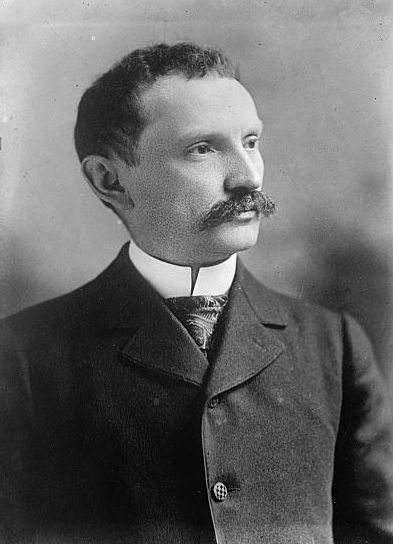
Robert S Green, Governor of New Jersey (Wikimedia)
According to the 7 May 1887 edition of The Matawan Journal, New Jersey Governor Robert Stockton Green signed a horsecar railway bill on 30 Apr 1887. The article was mostly an opinion piece by the editor, who made vague complaints of unfair competition by Keyport against Matawan's potential interests in the development of a horse-drawn tramway in the Bayshore.

The 9 Apr 1887 edition had reported that the bill passed the Senate 14-0 and the Assembly 35-6. This second page item contained the full text of the bill.

The Horse-Car Railway Bill

     An act relating to the turnpike roads within incorporated towns and boroughs in this state.

    1. Be it enacted by the Senate and General Assembly of the State of New Jersey, That any street railway company duly organized pursuant to the law may construct and with horses may operate street railways for the transporting of passengers and chattels for hire upon and along such portion of any turnpike road as enters and is located within the limits of any incorporated town or borough in this state, and upon and along such portion of such turnpike as extends outside such limits for the distance of thirteen hundred yards in either direction, after having obtained the consent of the owners of such turnpike so to do; provided that an ordinance or resolution authorizing the construction of such railway shall have been first passed or adopted by the commissioners of any such town or borough, and that the written consents of not less than two-thirds of all the persons owning lands abutting on such portion of such turnpike in each and every incorporated town or borough shall have been first obtained and filed in the office of the clerk of the county wherein such turnpike is situate.

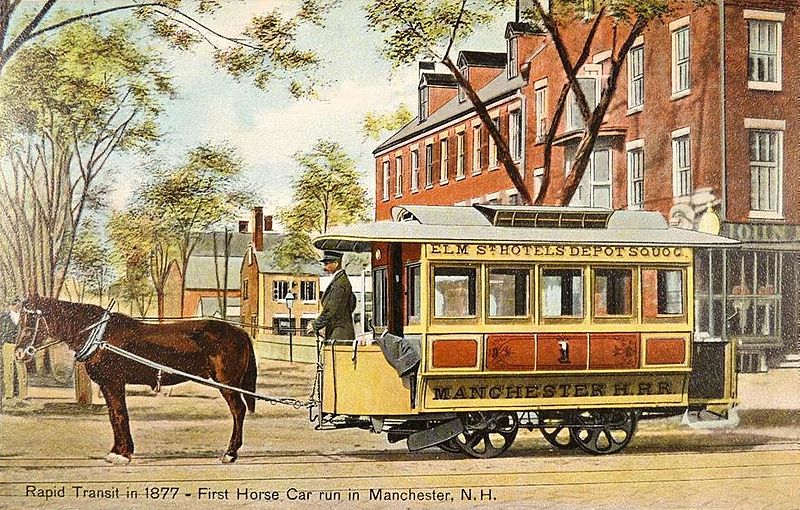
Manchester, New Hampshire added horse car in 1877. (Wikimedia)
     2. And be it enacted, That any turnpike or plank road company may sell, convey, assign and by written instrument of conveyance transfer and set over to any such street railway company any such portion of any such turnpike or plank road, together with all rights, title and interest to and in such turnpike or plank road, together with all franchises and appurtenances thereto pertaining, including the right to impose and collect tolls thereon, whereof such turnpike or plank road company shall be seized, enfranchised or invested, and any such street railway company may purchase, acquire title to and hold and enjoy the same, and may become invested and enfranchised with, and may exercise all such franchises and rights to the same extent and fully and in similar manner as therefore held, enjoyed and exercised by such turnpike or plank road company and subject to the same penalties and liabilities thereto attached for failure to maintain such road in good condition and repair, provided that the provisions of this section shall not take effect until the provisions of the first section shall have been fully complied with.

     3. And be it enacted, That the track and road bed of any such street railway upon such turnpike road shall be constructed in such manner as shall offer no unnecessary obstruction to travel upon such turnpike, and where any repairs thereunto may afterwards become necessary, it shall be the duty of such street railway company to make the same without delay, and if not so made, and after five days' notice shall have been given to such company the commissioners of the town or borough which such repairs may be necessary may cause the same to be made at the expense and charge of such street railway company, and the property of such street railway company shall be liable to distraint therefor; nothing in this act contained shall apply to any street railway within any city of this state.

     4. And be it enacted, That all laws and parts of laws conflicting herewith, in so far as they conflict herewith, are hereby repealed, and that this act shall take effect immediately.

Sunday, September 30, 2012

History: Adoption of the Electric Chair in NJ (1906)

Edward C Stokes (Wikimedia)
The 12 Apr 1906 edition of The Matawan Journal reported that NJ Governor Edward C Stokes signed the "electrocution bill," taking murderers off the gallows and putting them in the electric chair. The new form of capital punishment, considered less harsh than hanging, would go into effect on 1 Mar 1907. On the occasion of the bill's signing, Governor Stokes said, "This is a good law and I am glad to have the opportunity to approve it. I believe in it, for I am convinced that death by hanging is a brutal method."

Experimentation on the use of electrocution for capital punishment was done by Harold P Brown at Thomas Edison's laboratories in West Orange, NJ in the late 1880s. While Edison's better-known name is sometimes associated with the device, Brown is the actual inventor of the chair.

The first execution using an electric chair took place in New York State in 1890. The execution took eight minutes and was quite messy, prompting George Westinghouse to comment that "they would have done better using an axe."A reporter on the scene commented that electrocution was far worse than hanging.

Edison and Brown demonstrated the effectiveness of the use of alternating current for electrocution by killing a circus elephant in 1903.

Saturday, September 29, 2012

History: County Sheriffs in NJ Lose Earnings from Bankruptcy Fees (1878)

The 28 Sep 1878 edition of The Matawan Journal said that county sheriffs in New Jersey had stopped receiving an "additional twenty-five cent fee" related to their duties related to Federal bankruptcies as of 31 Aug 1878.

After the Federal government passed the Bankruptcy Act of 1846 (An Act to establish a uniform system of bankruptcy throughout the United States), Trenton passed a statute authorizing a schedule of fees for state officials handling bankruptcies. When the 1846 Act was revised 2 Mar 1867, Trenton revised its fees the next year.

On 14 Mar 1871, Trenton passed a supplement to the state fee statute authorizing county sheriffs to receive a fee of "twenty-five percentum additional in each case for all services to be by them performed." (Doesn't sound like 25 cents to me.)

The 1871 supplement included a caveat that the fee to sheriffs would no longer be authorized if the original Federal Act expired. Wikipedia's History of Bankruptcy Law in the US (footnote 3) says the Act of Mar. 2, 1867 was recorded as section 11, 14 Stat. 521, amended in 1874 as 18 Stat. 182, and repealed in 1878.

Saturday, September 22, 2012

History: Call for Network of Stone Roads in New Jersey (1899)

The 21 Sep 1899 edition of The Matawan Journal included a lengthy front page article discussing The Red Bank Register's call for a network of county stone roads to facilitate both commerce and recreational travel. Cars were becoming more popular, so people needed roadways spanning the state, as well as local roads connecting to these arteries. Construction costs would be shared between the state, county and local governments, but the roads would eventually be managed by the state.
  • Red Bank to Eatontown (this year, to complete route to Belmar)
  • Belmar to New Brunswick (2 sections need to be completed next year)
  • Atlantic Highlands to Matawan (next year?)
  • Oceanic to Red Bank (next year?)
  • Belmar along the coast to Atlantic City (a few miles each year)
  • Atlantic City to Cape May (existing)
  • Two northbound routes from New Brunswick
  • A major north-south route is underway in the western part of the state
  • A major north-south route is underway in the central part of the state
  • Asbury Park to Freehold (future, after shore road completed)
  • Shrewsbury to Freehold (future, after shore road completed)
  • Matawan to Freehold (future, after shore road completed)
  • Eatontown to Tinton Falls (future, to complete E-W route to shore)
  • Freehold southwest, west and northwest to major road in western part of the state
  • Oceanic bridge to Atlantic Highlands (planned)
  • Matawan to Old Bridge (planned)
  • Old Bridge to New Brunswick (completed)

Friday, August 31, 2012

History: Raritan Bay Pollution Symposium, Keyport (1953)

The 5 Mar 1953 edition of The Matawan Journal covered a Raritan Bay pollution symposium held at Keyport Borough Hall on 27 Feb 1953. The front page article was titled Mayor Scholer Protests Sewer Plan: Union Beach Officials Charge State Board, Legislature Knew Pollution Cause.

Government officials from Keansburg, Keyport, Union Beach, Matawan Borough, Matawan Township, Perth Amboy and South Amboy, as well as local industry representatives, gathered at a symposium in Keyport convened by Keyport Mayor Herbert R Rothenberg to discuss the growing problem of the pollution of Raritan Bay. Of particular concern to those gathered was the pitiful state of the the bay's shellfish industry, which was being put out of business by pollution caused by the dumping of industrial wastes and sewage effluent into the Hudson, Passaic, and Raritan rivers and the Raritan Bay itself.

Experts and state authorities came to the meeting to advocate for a new sewer treatment system that would heavily treat local sewage with chlorine then pump the processed sewage into the bay a full two miles off Laurence Harbor. In several years the system promised to remove water pollution from the waters around the Amboys and begin to bring back the shellfish industry.

The symposium was startled when Union Beach representatives in attendance refused to accept the assurances of NJ state health officials and legislators that the outflow from the proposed Raritan Valley Trunk Sewer would not contaminate the bay. Instead of going along with the proposal, the Union Beach officials accused the state of long turning a blind eye to influential polluters and leaving a real mess.

The NJ Public Health Service noted that fecal coliform bacteria levels in the Amboy channel were stable between 1915 and 1941 tests at 80 per 100 mm, but ten years later the level was 20 times higher. Exacerbating the problem was the faulty plant run by the Passaic Valley Sewer Commission. He thought those levels would improve with the construction of new treatment plants at Hunt's Point, Owl's Head, and Rockaway in New York City and a new plant at Linden-Elizabeth in New Jersey.

A Rutgers University expert said voluminous samples were taken of the waters of the Raritan Bay in 1950 and, except for the high values in the Amboy channel, the bay seemed to be in good condition. In an apparent reference to the nascent pharmaceutical industry along the Raritan River, the Rutgers expert asserted that the manufacture of certain drugs had been the primary cause of the sharp increase at the Amboy Channel.

The Rutgers expert admitted that the proposed plant would not meet state requirements for dissolved oxygen content but thought that the bay could deal with it naturally. ". . . the discharge would not be 'crystal clear water fit to drink' but felt the bay's capacity of self-purification would dispense all offensive matter a few hundred yards from the nozzles and the intense chlorination at the South Amboy chlorination plant." He also noted that 2/3rds of bay pollution came from industrial sources, not sewage.

It was here Mayor Scholer intervened to protest there wasn't a "decent disposal plant in the State of New Jersey" and he did not see why people living in towns along the bay had to be subjected to the gamble that the trunk sewer treatment plant would properly handle all the sewerage and wastes of the Raritan Valley due for dumping in bay water. He wanted to know why the Raritan Valley Sewerage Authority was not called the "sewerage dumping authority."